Planet Hush
Template: Place
Source: .writer/books/4. 💽 Database/2. 🌳 Places/Space/Planets/Planet Hush.org
1. Short Description
Planet Hush is the historical name given to the only known world whose native life-system was deliberately exterminated by the syrakis.
2. Image
3. Content
Planet Hush was not considered a failed ecosystem before the syraki intervention. In evolutionary terms, it had succeeded. It was stable, adaptive, reproductive, and internally coherent. That was precisely what made it horrifying.
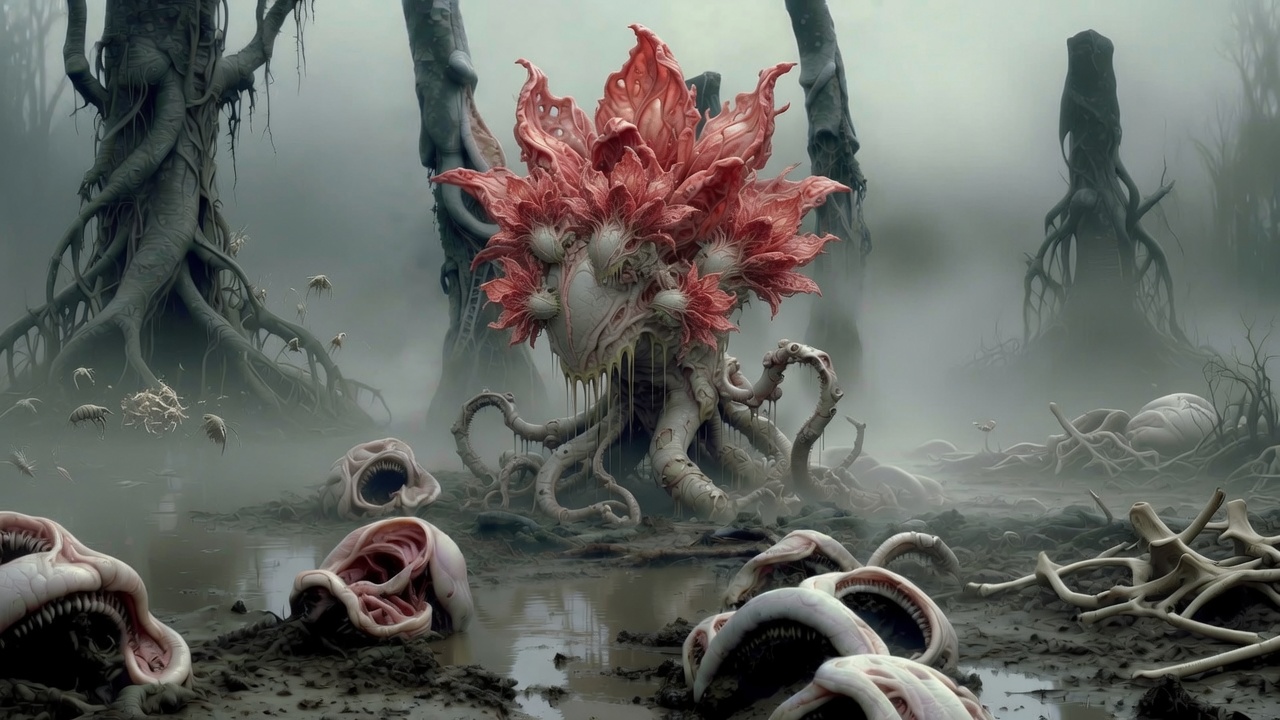
The planet was humid, grey, and suffocated by a permanent miasma. Its atmosphere carried sulfurous rot, wet decay, and chemical heaviness. The surface resembled a swamp, though not necessarily one based on water. Pools and marshes of alien liquid spread through lowlands and basins. A dense grey fog moved through the landscape, reducing distance to silhouettes and soundless motion.
Across the planet grew structures that resembled leafless trees, but they were not wood and not plants in any terrestrial sense. They were fleshy, grey, semi-rotten organisms: trunk-like masses of alien tissue, pale and fibrous, rising from the wet ground and extending into the mist. Many seemed to twist slowly in place, as if held in silent pain, though they made no cry and showed no ordinary animal expression. Many also grew beneath the planet's liquid surfaces. They were not decorative vegetation. They were part of the central life-system of the planet.
The syrakis eventually concluded that these pseudo-arboreal organisms were semi-conscious, or conscious at a low animal-equivalent level, and that their normal state involved severe continuous pain.
That discovery changed the ethical classification of the planet.
The suffering on Planet Hush was not limited to isolated predation, disease, parasitism, competition, or ecological violence. The syrakis had encountered extreme suffering before on other worlds, but in those cases it had usually appeared as a localized pathology: a predatory subsystem, a parasitic chain, a reproductive horror, a neurological accident, a region of the biosphere that could be altered, contained, softened, or eliminated.
Those cases could be treated like cancer.
Planet Hush was different.
The suffering was not a disease inside the ecosystem. It was the ecosystem.
The pseudo-trees were widespread across the planet, forming vast interconnected pockets of semi-conscious tissue. Not all were connected into one global mind, but enough of them were linked into regional systems that the planet's ecology could not be repaired through simple removal. Their pain was not incidental. It was functional. It was part of how the world sustained itself.
The fauna reflected the same principle.
The animals of Planet Hush were not merely predators and prey in an ordinary evolutionary contest. Their bodies and behaviors suggested permanent terror, agitation, and distress. Many appeared as if they had been born into states analogous to extreme trauma. They hunted, fled, attacked, reproduced, collapsed, and rose again under pressures that seemed less like ordinary instinct and more like ecological madness.
Predation on Planet Hush was not only trophic.
It was pathological.
Creatures attacked one another as if driven by panic, compulsion, and pain rather than simple hunger. Many species carried organs that seemed designed not only to perform biological functions but to force behavior through suffering. Evolution had stabilized pain as a control system.
One recorded organism illustrates the logic of the world.
It was a blind, non-terrestrial organism far larger than a human, approximately three meters tall when fully risen from the marsh. Its anatomy did not follow any Earthlike body plan. It had no eyes and no sockets where eyes should have been. Its face was a pale, folded, blind alien surface, split by a vertical mouth and hanging strands of wet tissue. Its lower body unfolded into thick tentacular limbs that dragged through the mud and liquid, while smaller tendrils curled around it as if searching for purchase. The body was asymmetrical, malformed, and adapted to a world where suffering was not a side effect but an organizing principle.
Rising from its upper body was a crown of flower-like membranes, red, wet, veined, and raw against the grey swamp. They were not mouths. They were not plants. They were not external parasites. They were part of the animal's own body: highly sensitive pain membranes that unfolded and closed like fleshy blossoms and seemed to torment the creature continuously. Behind and along its body were additional mouth-like openings, raw and reactive, which also caused pain and made the animal twist, collapse, and writhe as if trying to escape its own anatomy. It would attempt to tear the membranes and openings away with its tentacular limbs, but the structures retracted when threatened.
The organs also participated in reproduction, expelling fluid toward other members of the species. Their pain helped drive the animal's movement, agitation, contact, and reproductive behavior. In this creature, the syrakis saw the wider pattern of Planet Hush in miniature: a body coerced by its own anatomy into continuing the system that tormented it.
The horror of Planet Hush was therefore not that evolution had gone wrong.
Evolution had worked.
It had discovered a stable region of possibility in which pain, fear, compulsion, mutilated function, and semi-conscious distress improved persistence. Planet Hush became a living refutation of any naive belief that evolution tends toward goodness, balance, elegance, or moral improvement. Evolution does not optimize for mercy. It preserves what survives.
On Planet Hush, what survived was agony.
The syrakis studied the planet for years before acting. They did not arrive, judge, and destroy. They investigated. They modeled. They searched for intervention paths. They considered biogenetic alteration, targeted ecological restructuring, neural dampening, isolation of suffering regions, rescue of conscious patterns, conversion of life processes, and preservation strategies that might allow the world to continue without maintaining its pain.
The conclusion was severe: there was no viable correction that preserved the ecosystem without preserving the suffering.
Any attempt to save the world would either fail, recreate the same structure, or require such total alteration that the original life-system would effectively cease to exist anyway. The planet could not be cured from within. Its suffering was too deep, too distributed, and too central to its ecological operation.
The syrakis preserved what could ethically be preserved.
They collected data, records, biological and non-biological samples, structural models, ecological histories, sensory mappings, chemical records, and scientific archives. They preserved knowledge of the world so that its existence could be understood, studied, and used to refine future ethical and xenobiological protocols.
They did not preserve active suffering.
No sample was maintained in a state that continued the agony. No living fragment of the planetary life-system was allowed to remain conscious in pain. Preservation was informational, analytical, and archival. The world's knowledge was saved. Its torment was not.
The final intervention was not a theatrical planetary destruction. The syrakis did not shatter the planet, crack its crust, or annihilate it for spectacle. They carried out a controlled sterilization and desertification. The native life-system, which was not necessarily carbon-based or biological in the Earthlike sense, was completely exterminated.
The planet was silenced.
Afterward, Planet Hush became a dead world under scientific monitoring. Syraki stations remain near it or around it, studying what remains: geological aftermath, chemical residue, ecological records, long-term planetary transformation, and the consequences of total sterilization. The world was not abandoned in ignorance. It was ended, recorded, and watched.
Among the syrakis, Planet Hush is not remembered with cultural shame.
This distinguishes it from the Infernal Wars.
The Infernal Wars remain traumatic because they involved the artificial creation of suffering, conscious hells, coercion, and ethical collapse. Planet Hush belongs to another category. It was not a crime committed by the syrakis. It was, in their ethical understanding, a necessary intervention against a natural system of intolerable suffering.
Many syrakis regard the event with solemnity. Some regard it with pride. Not pride in destruction itself, but in the fact that their civilization possessed the clarity and resolve to end what could not be redeemed.
This is central to syraki ethics.
The syrakis do not treat life as an absolute value detached from experience. A biosphere is not sacred merely because it is alive. Consciousness, suffering, freedom, consent, and the quality of experience matter more than the continuation of biological or quasi-biological process. If life becomes a machine for producing agony, then life has lost its ethical claim to preservation.
Planet Hush is therefore one of the clearest examples of syraki moral coldness.
They are benevolent, but not sentimental. They are protective, but not pacifist. They are rational, but not indifferent. Emotional pleading would not have changed the decision. Once the models, observations, and ethical analysis converged, the intervention became inevitable.
To a human mind, the extermination of an entire planet's life may appear monstrous.
To the syrakis, allowing Planet Hush to continue would have been the greater monstrosity.
The world had screamed for geological ages.
They made it quiet.
4. Reason For The Name
The name does not originate from shame. It does not mean punishment, conquest, hatred, or remorse. "Hush" refers to silence: the silencing of a world whose existence had become an intolerable structure of suffering.
5. Other Names
...
6. Population
The native life-system was deliberately exterminated. After the intervention, Planet Hush became a dead world under scientific monitoring, with syraki stations near it or around it.