Omniship ZF-78
Template: Place
Source: .writer/books/4. 💽 Database/2. 🌳 Places/Omniships/Omniship ZF-78/Omniship ZF-78.org
1. Short Description
The auxiliary craft attached to RT-874, designed for local excursions, route preservation, and limited independent operation.
2. Image
3. Content
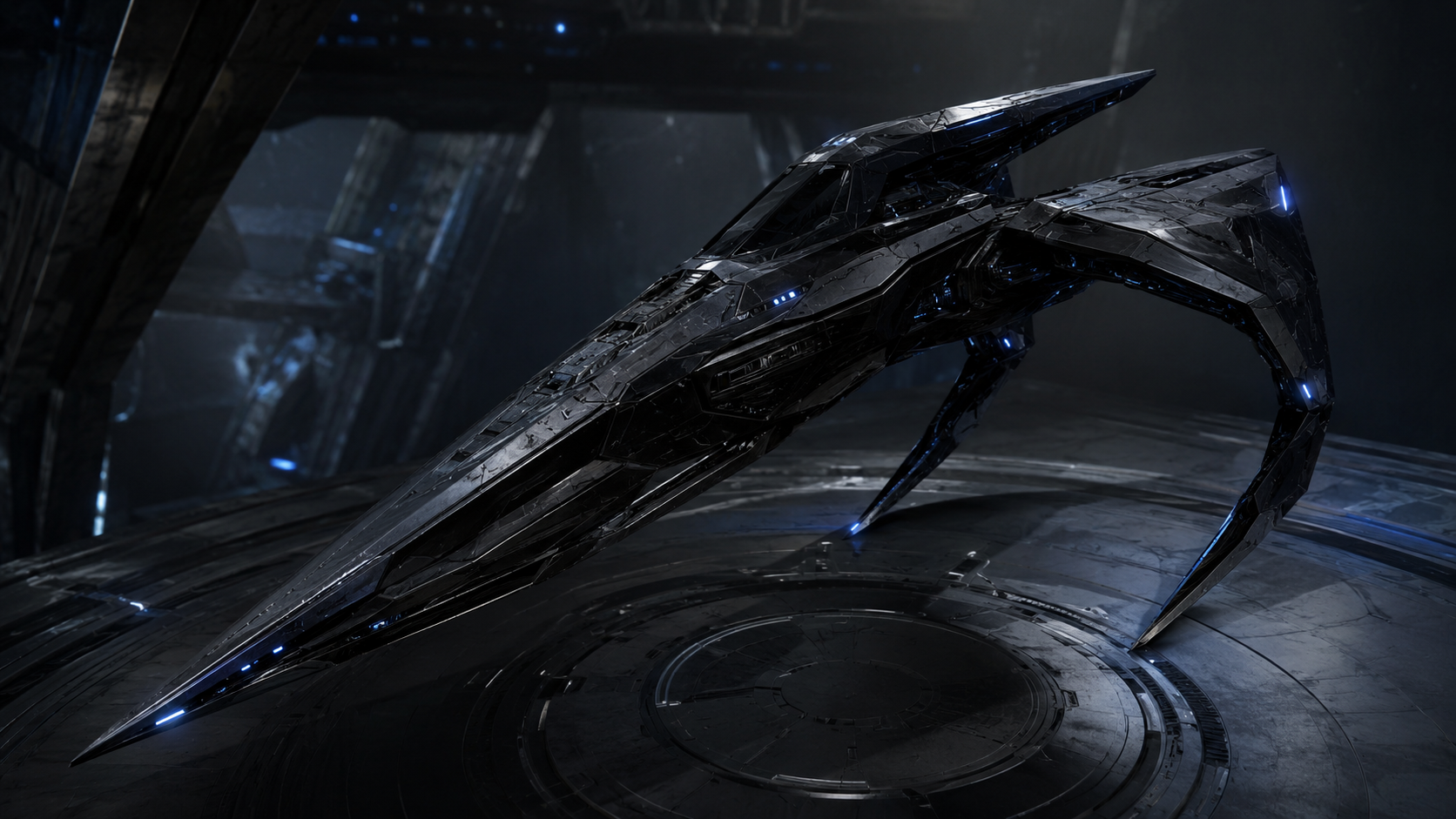
The ZF-78 is the auxiliary craft attached to the RT-874. It is not an attack ship, not a general escape pod, and not a smaller version of the RT-874. It is an excursion craft designed to extend the operational autonomy of the mothership.
Moving the RT-874 through space is expensive not only because of its mass, but because the vessel carries an entire mission infrastructure: crew-support systems, downgraded syraki consciousness substrates, Kallom-4000, laboratories, redundancy layers, cohesion architecture, internal environments, stabilization systems, and the computational machinery required to keep the expedition viable. Diverting such a vessel from its optimal route is costly and dangerous.
The ZF-78 solves that problem.
It allows the RT-874 to remain on an ideal trajectory or in a safer operational position while a smaller craft investigates nearby locations, unstable regions, inconvenient approach vectors, or sites that would not justify moving the entire omniship. In this sense, the ZF-78 functions like a needle deployed from a much larger body. The RT-874 carries the mission. The ZF-78 touches the target.
This was part of the RT-874's design from the beginning. Omniship construction, during the period of the novel, is still young, experimental, and only partially standardized. These vessels are not mass-produced industrial objects. Each omniship is closer to a singular engineered artifact, shaped by accidents, prior studies, corporate doctrine, mission requirements, and lessons learned from earlier failures. The inclusion of the ZF-78 reflects Theravada Corporation's understanding that energy economy, route preservation, and local maneuverability are central to long-range omniship operation.
The ZF-78 is optimized for a maximum of two members. Under normal conditions, one or two downgraded syraki operators can function inside it at roughly the same conscious level they maintain aboard the RT-874. The operators themselves are not reduced far below their shipboard state simply because they enter the ZF-78. What is reduced is the surrounding support architecture. Compared to the RT-874, the ZF-78 has far less computational power, far less autonomy, weaker redundancy, fewer stabilization layers, and a much smaller tolerance for failure.
The craft can draw on the computational resources of the RT-874 when the mothership is available, using it for calculation, navigation, support, and operational optimization. However, the ZF-78 was also designed to survive partial or total loss of mothership support. If contact with the RT-874 is lost, the craft can continue operating independently, though with sharply degraded capacity and a narrower margin of safety.
The ZF-78 belongs physically and narratively to the Burrow, the lowest operational level of the RT-874. When docked, it rests in a recessed cradle surrounded by power conduits, locking arms, diagnostic ribs, coupling sockets, and launch rails. When absent, it leaves the Burrow visibly incomplete, as if the ship's smallest and most specialized extension has already reached outward.
4. Reason For The Name
...
5. Other Names
...
6. Population
...