Interior Of Omniship RT-874
Template: Place
Source: .writer/books/4. 💽 Database/2. 🌳 Places/Omniships/Omniship RT-874/Interior of omniship RT-874.org
1. Short Description
...
2. Image
3. Content
...
3.1 Zeroth Level - The Observatory
3.1.1 Image
3.1.2 Content
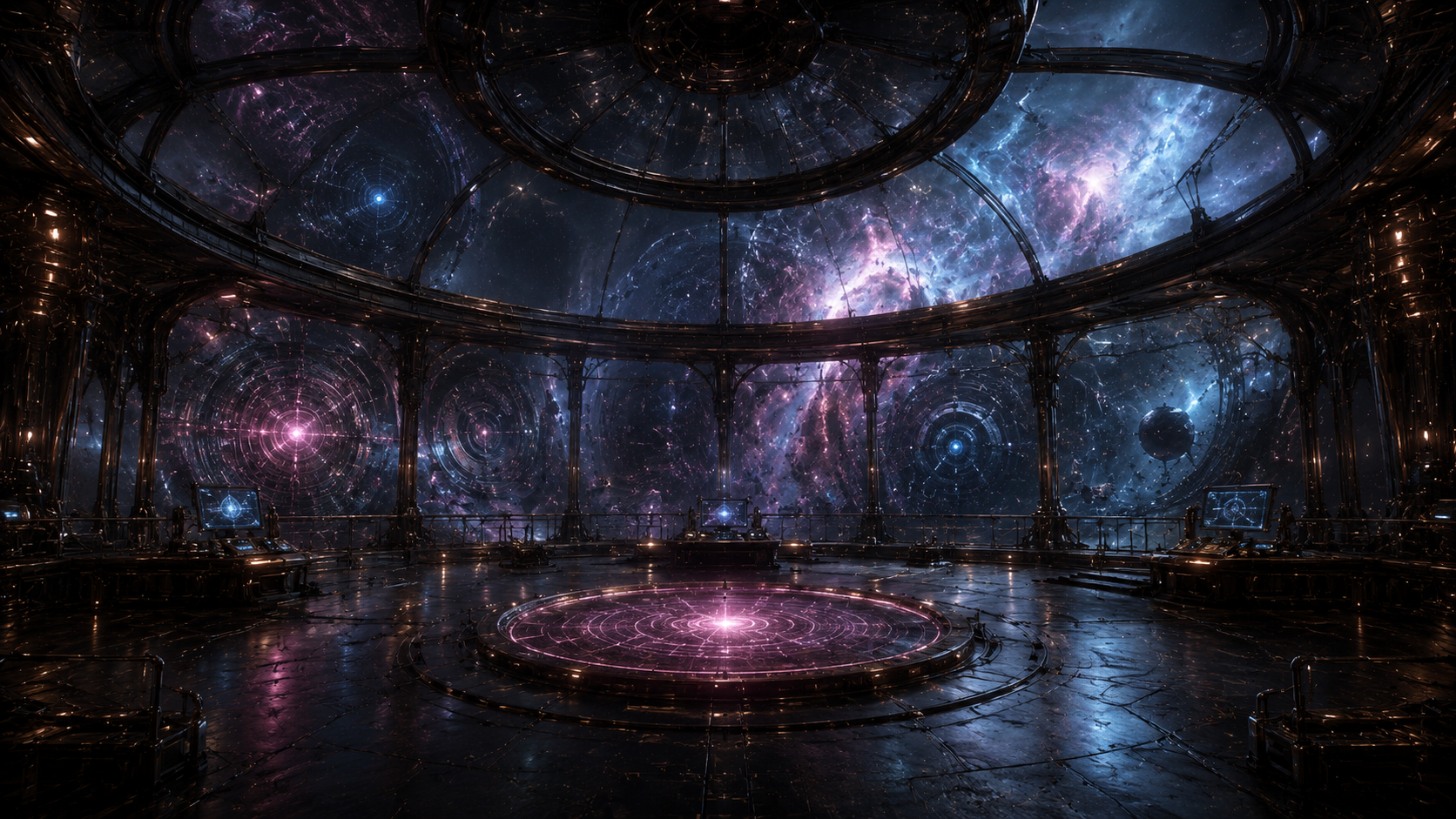
The Zeroth Level of the RT-874 is the Observatory. It is not a command deck, research laboratory, or operational control room in the ordinary sense. It is a circular observation chamber built around the old and simple idea of a dome: a place where one enters, stands beneath a transparent surface, and looks outward. In contrast to the bridge, which is dense with stations, screens, cables, controls, helmets, holographic systems, and technical interfaces, the Observatory is comparatively sparse. It contains only a limited number of computers and instruments because its primary function is not to operate the ship, but to reveal what lies beyond it.
The Observatory is accessed through the pink circular transport pad located near the center of the bridge. This pad is separate from the main elevator used to move between most levels of the RT-874. It leads only upward, from the bridge to the Zeroth Level. When a user steps onto the circle, the pad responds as the other internal transport systems do, but the available command is only ascent. The Observatory therefore occupies a special position in the ship’s architecture: it is above the bridge, reachable from the command center itself, and separated from normal internal circulation.
The chamber itself is always active. It is not dark, dead, depowered, or waiting to be repaired. The reason Mike and Kallom-4000 cannot access it at first is not mechanical failure, but security encryption. After the crash, the access route to the Zeroth Level became encrypted under captain-level authority. Only Captain Rüdolf can release it. When Mike attempts to use the transport pad without that authority, the system rejects the command with the message “Access negated.” This makes the Observatory an active absence within the early structure of the novel: the place is functional, the entrance is visible, the destination exists, but the path is sealed.
This restriction gives the Observatory a different narrative weight from the other levels. It is not merely another locked room. It is the only place in the ship designed to show the outside, and the RT-874 otherwise provides no windows, no external camera feeds, no visual apertures, and no reliable exterior view. The bridge can calculate, diagnose, speak, and display internal systems, but it cannot show Mike what surrounds the vessel. When Kallom-4000 says that, according to the data still available to him, there is nothing outside, the Observatory becomes the one remaining promise of direct confirmation. It is the level that may answer whether the ship is surrounded by space, void, absence, or something for which those words are no longer adequate.
Architecturally, the Observatory is simple enough that it should not steal attention from what it reveals. It is a circular hall with a transparent dome above it, made from glass or an equivalent material advanced enough to belong inside a syraki-built omniship. The space may contain a few instruments, low consoles, diagnostic terminals, or passive monitoring systems, but it is not crowded. Its purpose is visual confrontation. The bridge mediates reality through instruments; the Observatory removes that mediation. It allows the crew to look outward directly, or as directly as the RT-874 can permit.
When the Observatory finally becomes accessible, the impact of the scene should come almost immediately from what appears beyond the dome. The room itself establishes orientation, but the true revelation is outside. Until that moment, the ship has enclosed Mike and the crew inside a condition of windowless uncertainty. The Observatory breaks that enclosure. What they see beyond the dome is magnificent, strange, and deeply wrong. The appropriate first response is not technical explanation, but shock: the kind of reaction that reduces even advanced minds to a crude sentence like, “What the fuck is that?”
The Zeroth Level therefore functions as a delayed revelation device. It is introduced early as a visible but unreachable destination, protected by Rüdolf’s authority and sealed by post-crash encryption. Its existence keeps pressure on the bridge: the ship contains a place built to see outside, but the crew cannot reach it. When they finally do, the Observatory does not merely provide visual information. It changes the meaning of the RT-874’s situation. It reveals that the absence of windows was not just a design choice, and that the statement “there is nothing outside” was not a sufficient description of the condition surrounding the ship.
3.2 First Level - The Commanding Center
3.2.1 Image
3.2.2 Content
...
3.2.2.1 The Bridge
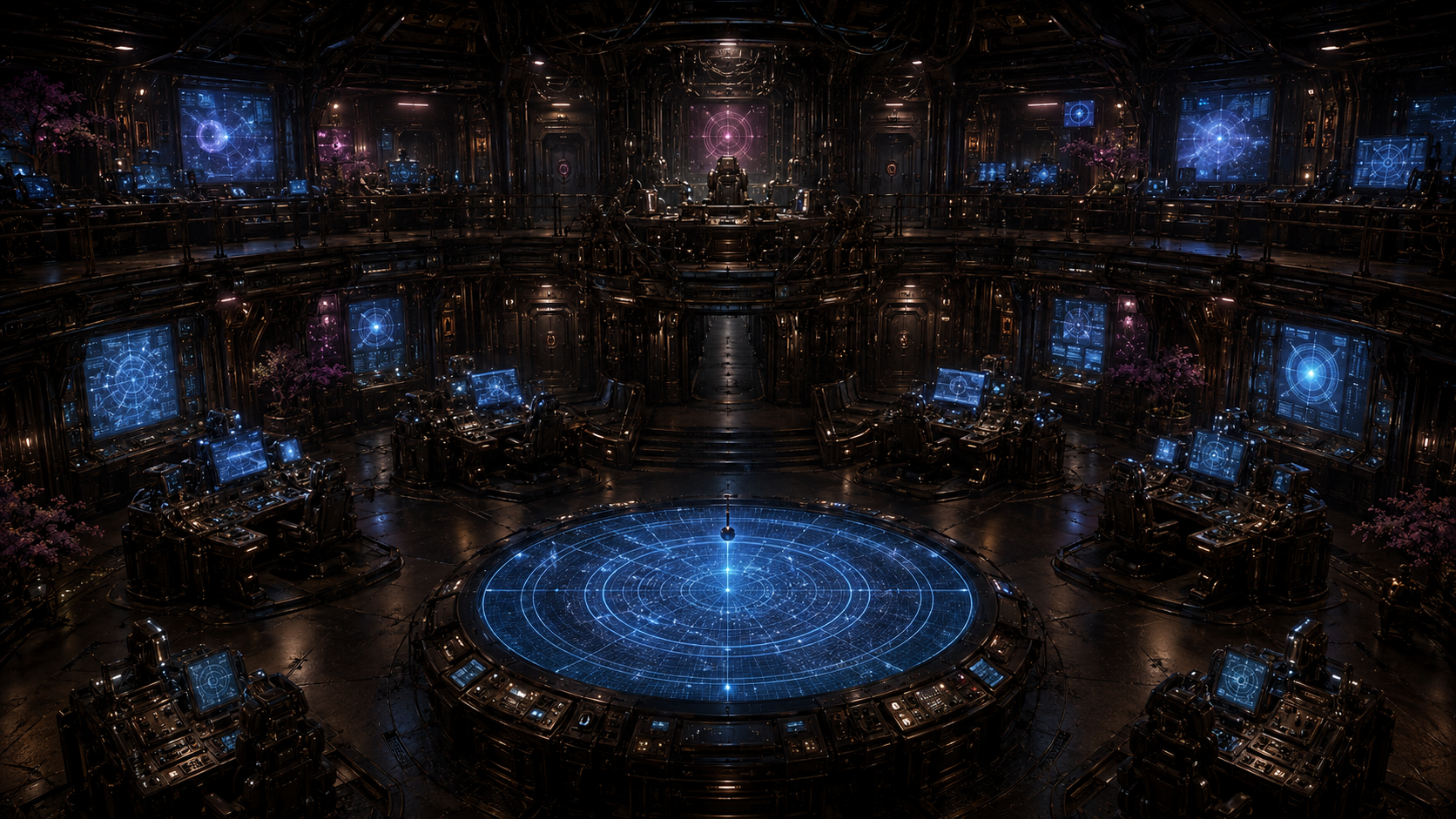
The First Level of the RT-874 is the bridge: the central command level of the omniship and the first true operational environment Mike encounters after leaving the initial desert condition. It is not a conventional spaceship bridge, nor does it resemble the open and clean command decks associated with older space opera imagery. It is a large, enclosed, oval command laboratory, spacious in physical scale but claustrophobic in atmosphere. Its size, density, and complexity suggest a vessel far more advanced than any ordinary ship, yet the room also carries a strangely human tactile quality: chairs, screens, buttons, levers, cables, helmets, consoles, and visible manual interfaces. Later, this becomes understandable as part of the RT-874’s design language, which was partially modeled on historical human spacecraft data in order to make the vessel operable for syrakis in downgraded humanoid states.
The bridge has no windows. It has no external camera feeds available to Mike, no visual aperture, no observation screen, and no reliable way to see outside the omniship. This absence is one of the first details that makes the room feel wrong. Syraki engineering could easily produce external vision if external vision were desired, even if physical windows were structurally undesirable. A ship occupied by embodied crew, robotic systems, or downgraded operators would normally include some form of visual reference for navigation, docking, external diagnostics, or situational confirmation. The RT-874 provides none. When Mike asks Kallom-4000 what exists outside, Kallom can only state that, according to the remaining data available to him, there is nothing. This does not mean an empty void in the ordinary sense. An empty void is still a region. It has extension, relation, measurable absence, and semantic stability. Kallom’s answer indicates something worse: the available instruments do not confirm an exterior environment at all. Even the word nothing becomes inadequate, because the condition outside the ship appears to empty the very concepts of exterior, void, space, and environment.
The main chamber is organized around ten crew stations, one for each member of the crew. Each station bears the human name of its assigned operator. These names are not ornamental; they are part of the historical and functional design of the bridge, reinforcing the strange mixture of posthuman engineering and human-readable interface. The ten stations are not identical. Each one is built around the specific role of its operator, with comfortable seating, surrounding consoles, specialized screens, buttons, levers, physical controls, data interfaces, cables, and a neural helmet or head-interface device attached to the seat. A pilot’s station emphasizes navigation, movement data, trajectory, and vessel handling. A psychological or cognitive station emphasizes mental states, crew stability, subjective continuity, and cognitive diagnostics. Other stations are arranged according to their functions. Similar functions are placed closer together, so the bridge does not feel like a decorative circle of chairs, but like an integrated operational system divided into clusters of responsibility.
The captain’s station belongs to Rüdolf. It is elevated above all the other stations and visually dominates the bridge. From this position, the captain can see the entire command floor and maintain a holistic overview of the ship’s systems, crew states, navigation conditions, mission data, and internal alerts. The elevation is not merely aesthetic. It makes command part of the architecture itself. The captain’s station is the point where specialized systems converge into total operational awareness. While the other stations are built for particular domains, the captain’s station is built for integration.
In front of the crew stations stands a large circular holographic table called the Plotter. When Mike first arrives, the Plotter is inactive. Later, when activated, it projects a military-style mathematical representation of the RT-874’s position. The display resembles a tactical terrain table or strategic command map, but its content is not geographical in the ordinary sense. The most unsettling feature is a single black point suspended above the holographic field, motionless. Mike understands that the point represents where the RT-874 is, or at least the closest mathematical representation of what remains of that idea. The stillness of the point is more disturbing than motion would be. It suggests not that the ship is stationary in normal space, but that the conditions required to describe movement, location, and exterior reference have become unstable or incomplete.
Near the center of the bridge there is a discreet pink circular transport pad embedded in the floor. It is visible but not visually dominant. When someone steps into it, the circle glows more intensely. This transport pad is not the main elevator used to move through the ship. It leads only upward, to the Zeroth Level: the Observatory. Because access to the Observatory requires Captain Rüdolf, Mike and Kallom-4000 cannot use it while Rüdolf remains missing. This makes the pad an active absence within the bridge. The path to one of the ship’s most important and mysterious spaces is physically present, but unavailable. It marks the limit of Mike’s authority and the incompleteness of the ship’s recovered command structure.
The main transport elevator is separate. It is located farther back, near the end of the rear corridor, away from the central crew stations. Like the other internal transports of the RT-874, it is not a mechanical lift or conventional elevator cabin. It functions as an instantaneous transport system between levels, based on a circular floor interface and internal controls. A person steps into the transport area, selects the desired direction or level, and is moved instantly to another part of the ship. This gives the RT-874’s internal structure a strange discontinuity: the levels are treated as spaces connected by transport events rather than by stairs, shafts, or ordinary vertical travel.
Behind the main operating area, a corridor leads toward this primary transport elevator. Along that corridor are four additional doors, two on each side. Each door opens into an auxiliary technological room roughly the size of a standard classroom, around fifty square meters. These rooms are not decorative offices. They are support chambers linked to the bridge’s work: specialized rooms for research, diagnostics, maintenance, planning, and secondary operations. Their presence makes the bridge feel less like a single command deck and more like the central node of a larger operational complex.
The bridge also has an upper level. This second tier contains auxiliary computers, technical stations, support systems, additional consoles, and further screens. It reinforces the impression that the bridge is not a simple control room but a layered command laboratory. From above, systems can be monitored, cross-checked, and maintained without interfering with the main crew stations below. The upper level also gives the space a sense of vertical depth, making the bridge feel like a contained machine cathedral built for command, diagnosis, and coordination.
Kallom-4000 manifests throughout the bridge through screens, holographic systems, and independent displays. He does not need a single fixed body within the room. Instead, his presence is distributed through the bridge’s interfaces: wall screens, freestanding displays, holographic projectors, console surfaces, and voice. This makes him feel less like a character standing beside Mike and more like the remaining intelligence of the room itself. Because the bridge is filled with systems through which Kallom can appear, the line between ship, interface, and AI becomes deliberately unstable.
The atmosphere of the bridge is defined by contrast. It is large, but enclosed. It is advanced, but strangely manual. It is beautiful, but oppressive. It is functional, but partially inaccessible. It is built for command, but the captain is gone. It is full of screens, but cannot show the outside. It is designed to orient its crew, yet it now surrounds Mike with evidence that orientation itself has failed. This is why the bridge should never be treated as a simple location. It is the first major architectural expression of the RT-874’s condition: a perfect operational chamber trapped inside an impossible absence.
3.2.2.2 Main Database Room
One of these auxiliary rooms is dedicated to the Main Database. It contains maintenance terminals, diagnostic computers, screens filled with diagrams, system maps, data integrity displays, and interfaces connected to the damaged or inaccessible portions of Kallom-4000’s operational architecture. This room becomes important because Kallom’s access to the Main Database was sacrificed or lost during the catastrophe, leaving him functional but limited. The room is therefore not merely a technical annex. It represents the missing intelligence of the ship, the difference between Kallom’s damaged inference and his full operational memory.
3.2.2.3 Strategic Meeting Room
Another auxiliary room functions as a strategic meeting room. It is used for planning, briefing, mission reconstruction, and coordinated discussion. It contains seating, holographic instruments, displays, and interfaces designed to help the crew analyze mission conditions and formulate operational decisions. This room is more formal than the kitchen or lounge spaces elsewhere in the vessel, but less overwhelming than the bridge itself. It exists for collective interpretation: the place where data can be turned into plans.
3.2.2.4 The Alcove
A third auxiliary room functions as a molecular assembly kitchen and rest chamber. It contains technology capable of producing food, drinks, and other consumable substances through molecular assembly. It also includes seats and a more relaxed arrangement for rest, recovery, and informal conversation. This room is important because it introduces a more human layer into the bridge complex. Even inside a posthuman omniship, the downgraded crew require a place where eating, pausing, speaking, and recovering can happen within reach of the command level.
3.2.2.5 Cohesion Chamber
The fourth auxiliary room is the Cohesion and Reality-State Monitoring Room. This chamber is dedicated to measuring, diagnosing, and interpreting the instability affecting the RT-874 and the crew’s continuity. Its systems track decohesion, cohesion, reality-jump traces, temporal divergence, memory discontinuity, crew anchoring integrity, internal and external boundary readings, and mathematical anomalies in the ship’s relation to location. This room becomes one of the first places where the horror of the reality jumps begins to shift from pure experience into observable problem. It does not remove the terror, but it gives the terror instruments, diagrams, readings, and a technical vocabulary.
3.3 Second Level - The Research Center
3.3.1 Image
3.3.2 Content
...
3.3.2.1 Overview
The Second Level of RT-874 is known as the Research Center. It is one of the most important internal sectors of the omniship, though not one of the most immediately comprehensible. When Mike first enters it, the place does not present itself as a conventional laboratory wing, a hospital deck, or a biological research station. It feels closer to a sealed research station inside a spacecraft: enclosed, dark, pressurized, and withdrawn from any ordinary sense of environment.
The atmosphere is claustrophobic by design. The corridors are not ruined, dirty, or abandoned. They are intact, functional, and precise, but they carry the oppressive stillness of a machine that does not need human comfort. The light is low, indirect, and controlled. Surfaces absorb more illumination than they reflect. Doors close with the weight of containment. Sounds do not travel naturally. Every chamber feels insulated from every other chamber, as if the level were built not merely to host research, but to prevent contact between incompatible categories of knowledge.
Mike recognizes parts of the architecture. He has been inside many spacecraft. He understands the grammar of sealed compartments, emergency partitions, technical doors, diagnostic panels, and controlled internal circulation. Yet the Research Center disturbs him because recognition never becomes understanding. The rooms obey the logic of research, medicine, storage, engineering, and containment, but the matter under study does not belong to any field he can confidently name.
Nothing here feels theatrical. The horror comes from order. The level is not chaotic, not grotesque, not visibly broken. It is organized around systems that continue to function after the crash, after the disappearance of the crew, and after Kallom-4000 has lost access to the Main Database. The Research Center gives Mike the impression that the RT-874 was not only traveling somewhere. It was already studying something, collecting something, preserving something, and perhaps treating contact with that something as a technical problem.
Kallom-4000 can identify the rooms, their names, their surface functions, and some of their active connections. But without the Main Database, he cannot interpret the full purpose of the level. This limitation is crucial. The Research Center is not a simple mystery because its doors are closed. In many cases, the doors open. The machines respond. The screens activate. Data is visible. The problem is that the visible data does not resolve into meaning.
The Second Level contains seven major rooms:
Sick Bay - 250 m²
Room 0554 - 100 m²
Exopsychology Lab - 400 m²
Species Container A - 250 m²
Species Container B - 250 m²
Cold Storage - 200 m²
Systems Chamber - 700 m²
3.3.2.2 Sick Bay - 250 m²
The Sick Bay is one of the strangest rooms in the Research Center because its name suggests a function Mike initially understands. He expects a medical chamber: bodily repair, emergency stabilization, trauma response, biological maintenance, perhaps some downgraded approximation of syraki health care. Instead, he finds a room whose real emphasis is mental treatment.
The chamber is not large compared to the others, but it feels heavy. Kallom-4000 explains that the Sick Bay is the single room in RT-874 that requires the most computational power when active. It is not kept running continuously. Keeping it enabled without strict necessity would be dangerous, wasteful, or both. For that reason, Kallom keeps it disabled by default and activates it only when the situation demands it.
The room contains one primary treatment station: a chair or bed resembling a dentist’s chair, though more advanced, more enclosed, and more severe. Above it rests a single helmet-like interface. A dedicated computer stands beside the chair, linked directly to the apparatus. The existence of only one station is important. This is not a medical ward built for multiple patients. It is an intervention chamber for one mind at a time.
Mike finds this disturbing because the word “Sick Bay” belongs to an old category of expectation. The room subverts it. The body is not absent, but the body is not the center. The center is continuity, cognition, memory, trauma, decohesion, altered subjective duration, and the unstable conditions of conscious experience after contact with realities that do not behave like ordinary environments.
The Sick Bay exists to treat the mind under conditions that ordinary medicine cannot touch. Its danger comes from the same fact that gives it value: it can reach too deeply.
3.3.2.3 Room 0554 - 100 m²
Room 0554 is small compared to most chambers in the Research Center, but its importance is disproportionate. Its number carries cultural weight in syraki society. Mike understands immediately that 0554 is not an accidental designation. The number is charged. The mystery is not whether the room is important, but why such a room exists here, inside the Research Center of RT-874.
At first, Room 0554 is inaccessible. Unlike the Observatory, which is locked by captain-level authorization, Room 0554 is blocked because of a crash-related error. Kallom-4000 cannot correct the problem in his damaged state because he lacks the necessary access through the Main Database. The room therefore becomes a visible absence: a place the ship knows, a place the mission needed, and a place Mike cannot reach.
When the room is eventually opened, its purpose becomes clear. Room 0554 contains ten chairs, one for each member of the crew. Each chair has its own helmet-like interface and its own connected computer system. The stations are not interchangeable. Each one is calibrated to a specific member of the crew. If Mike attempts to use another person’s station, nothing meaningful happens. The interface requires the correct consciousness, continuity signature, or personal configuration.
Room 0554 is a RUN connection room. Its helmets do not connect the crew to ship systems in the same way as the bridge helmets. They connect the crew to worlds.
The most important of these worlds is The Base, a special RUN prepared as part of the original mission. The mission was so secret that the crew could not receive its full explanation before departure. Before entering RT-874, they agreed to participate in a dangerous, ultra-confidential operation in exchange for immense compensation. They knew the risk. They knew the secrecy. But they did not know everything.
The Base was designed to solve that problem. It is a sci-fi base located inside a forest, a controlled environment where the crew would receive the full explanation only after the mission had already begun. There, a scientist named Karl Cheng appears and explains what could not be revealed earlier.
Room 0554 is therefore not just a technical chamber. It is the mission’s delayed mouth. It is the place where secrecy was supposed to become knowledge.
3.3.2.4 Exopsychology Lab - 400 m²
The Exopsychology Lab is connected directly to Species Container A and Species Container B. Kallom-4000 can identify that connection, but he cannot fully interpret its meaning without access to the Main Database. He knows that the lab deals with mind. He knows that it deals with data. He knows that the amount of data involved is enormous, far beyond anything comparable to contemporary human storage. But he cannot say exactly what the stored structures represent.
The room is filled with computers, terminals, diagnostic systems, and interpretive interfaces. It is not a therapy room. It is not a classroom. It is not a human psychological laboratory. It is a place built to interact with stored mental, cognitive, or exopsychological structures held inside the Species Containers.
Mike understands enough to feel the scale of the problem, but not enough to name it. The room appears to be an interface between psychology and storage, between consciousness and data architecture. The systems do not merely display numbers. They seem to track patterns, divergences, recursions, signatures, and transformations that might correspond to minds or species-level cognitive structures.
The most unsettling fact is that the process is still active. While Mike and Kallom speak inside the lab, the Species Containers continue storing data. The process does not stop. It is automatic. It has been happening before Mike entered the room, and it continues while he stands there. The ship is still collecting or preserving something, even after the crash.
Mike asks whether the system has a mathematical storage limit. Kallom answers that it does. Nothing aboard RT-874 is infinite. But the limit is so vast that it is practically irrelevant in the present context. They are not close to exhausting it in any operationally meaningful sense.
The Exopsychology Lab thus creates a specific kind of fear. It is not the fear of a sealed monster behind glass. It is the fear of an archive that continues to fill itself with meanings no one present can read.
3.3.2.5 Species Container A - 250 m²
Species Container A is misleading by name. Mike expects physical containment. The phrase suggests tanks, pods, suspended organisms, sealed environments, biological samples, alien specimens, or something resembling a zoological or exobiological chamber. Instead, he enters a room filled with storage infrastructure.
The chamber resembles an advanced data center, though even that comparison is crude. It is not made of contemporary servers, hard drives, or SSDs. Its storage systems belong to RT-874’s technological scale. Massive columns, sealed arrays, silent processing racks, and dense informational vaults fill the room. The space is organized for high-capacity active storage.
Kallom-4000 describes its function in terms Mike can understand only approximately. Species Container A behaves like hot storage. The data inside is not merely archived. It is available, active, and connected to the Exopsychology Lab. It can be accessed, referenced, and processed by systems that Kallom can identify but not fully interpret.
The word “species” becomes stranger after Mike sees the room. The container does not hold visible bodies. It holds data. This suggests that what RT-874 calls a species may not be reducible to organisms in cages. It may mean cognitive patterns, population structures, mental architectures, stored models, informational organisms, or something that can be preserved only as data.
Species Container A is not empty. It already contains a great deal.
3.3.2.6 Species Container B - 250 m²
Species Container B mirrors Species Container A in size and general function, but its separate designation implies difference. Mike cannot immediately determine whether the distinction is categorical, chronological, operational, or risk-based. Kallom-4000 cannot resolve the distinction without the Main Database.
Like Container A, Species Container B does not contain visible biological specimens. It is another high-capacity active storage chamber. It is linked to the Exopsychology Lab and participates in the same continuous storage process. Data flows into the system automatically. The ship keeps storing information without waiting for Mike or Kallom to understand it.
The existence of two active Species Containers suggests division. Perhaps they store different classes of entities, different cognitive models, different phases of collection, different species-level structures, or different degrees of interpretive danger. The room itself gives no simple answer.
What matters for Mike is the reversal of expectation. A species container should contain life in a recognizable sense. This one contains data. Yet the architecture treats that data with the seriousness of containment.
3.3.2.7 Cold Storage - 200 m²
Cold Storage is also a storage chamber, but it differs from Species Container A and Species Container B in its operational state. It is not hot storage. It is not built for continuous interaction. It preserves.
The room is colder, quieter, and more inert than the Species Containers. Its systems are dormant or minimally active. The storage units do not suggest constant exchange with the Exopsychology Lab. They suggest retention, quarantine, long-term preservation, or informational suspension.
Mike can understand the distinction even if he cannot interpret the contents. Species Container A and B are active. Cold Storage is passive. The former are connected to ongoing analysis and automatic accumulation. The latter keeps what must not be touched unless needed.
The chamber’s stillness gives it a different dread. The Species Containers frighten because they continue to receive data. Cold Storage frightens because something has already been placed there and deliberately kept silent.
3.3.2.8 Systems Chamber - 700 m²
The Systems Chamber is the largest room in the Research Center. It replaces the expectation of a general laboratory with something more specific: an engineering and systems oversight chamber. When Mike enters, he recognizes its function almost immediately. The layout, the density of consoles, the arrangement of screens, the diagnostic architecture, and the spatial logic all tell him that this is a room for monitoring, maintenance, and technical control.
Yet recognition fails almost at once.
Mike has experience with spacecraft. He knows what engineering rooms usually show: power distribution, fuel systems, propulsion, thermal regulation, structural pressure, electrical load, life support, navigation support, reactor integrity, maintenance alerts, and damage reports. The Systems Chamber shows none of these in any familiar way. The screens are active. The data is abundant. The room is organized, disciplined, and clearly functional. But the categories are wrong.
The systems do not speak the language of conventional spacecraft engineering. They display other kinds of conditions: relations, states, tolerances, boundaries, patterns, and structures Mike cannot map onto the ship he thought he understood. Nothing appears random. Nothing appears broken. That is what unsettles him. The room is not incomprehensible because it is damaged. It is incomprehensible because it belongs to an engineering discipline beyond the one his downgraded mind can fully read.
The Systems Chamber connects to many parts of RT-874. It allows oversight of the omniship’s internal states, but not in the simple mechanical sense Mike expects. It shows a machine whose crucial systems may not be fuel, engines, wires, pumps, and pressure, but continuity, containment, state coherence, informational structure, access pathways, and mathematical conditions of operation.
The room gives Mike one of the clearest impressions of the RT-874’s true nature. The ship is not merely advanced. It is organized around categories that resemble engineering only from a distance.
The Systems Chamber is not chaos. It is order without translation.
3.4 Third Level - The Quarters
3.4.1 Image
3.4.2 Content
...
3.4.2.1 Overview
The Third Level of RT-874 is known as The Quarters. It is the residential level of the omniship and, at first glance, the closest thing aboard the vessel to something ordinary. Unlike the Commanding Center, the Research Center, or the sealed technical chambers, this level presents itself through recognizable categories: private rooms, a corridor, domestic space, social space, food, leisure, rest, conversation, and pleasure.
That familiarity is deceptive.
The Quarters are not designed like the crew cabins of a conventional spacecraft. Each apartment is too large. The lounge is absurdly spacious. The level feels less like a compact residential deck and more like a small inhabited environment embedded inside the body of the ship. Mike immediately recognizes the function of the level, but its scale unsettles him. A spacecraft, even a luxurious one, should economize space. RT-874 does not seem to care about that expectation.
The Third Level is important because it gives Mike the first strong experience of domestic continuity. The ship does not only contain mission systems and research infrastructure. It contains traces of living. It contains a room that belongs to him. It contains a social environment that reflects syraki hedonism more directly than any other part of the vessel. It contains comfort, but the comfort is not reassuring. It exists inside a broken mission, after the disappearance of the crew, under conditions no one can fully explain.
The Third Level consists of two main residential structures: the private crew apartments and the Lounge.
3.4.2.2 The Corridor and the Sealed Apartments
The residential corridor is approximately five meters wide. Along both sides are the private apartments of the ten members of the crew. Each apartment is approximately 100 m². This means that each crew member does not possess a mere cabin, but something closer to a full apartment.
There are ten apartments in total, one for each crew member:
Ismael Karlave Cossa
Oshiro Fratken
Felix Colomb
Rüdolf Bolton Nixilian
Elijah Kang Erva
Lucia Garrota de Irvis
Mike Rajhalo Spencer
Vladimir Dit Kuznetsov
Susan Lkravart Maneli
Beatriz Ferreira Augustiniana
Each door carries the name of its owner. The doors are sealed, and access is restricted to the corresponding crew member. Mike can enter his own quarters, but he cannot enter the others. Kallom-4000 also cannot see inside them. The interiors are encrypted even from him in his damaged state. He can verify certain external signals, such as t-signals, but he cannot inspect the rooms themselves.
This creates one of the first quiet horrors of the Third Level. The apartments are close, personal, and visibly connected to people Mike once knew, but they are inaccessible. He cannot know whether the others are empty, intact, occupied, damaged, frozen, preserved, altered, or full of evidence. He cannot know if someone is inside. He cannot even know if there is anything inside.
The corridor therefore becomes a domestic space haunted by sealed privacy. It is not a hallway of dead rooms. It is a hallway of unanswered lives.
3.4.2.3 Mike's Quarters - 100 m²
Mike's apartment is approximately 100 m². It is technologically advanced, organized, and strangely familiar. It contains a living area, a kitchen, a study environment, and a personal work station. It also contains notebooks, pencils, pens, and written material. These objects are recognizably human in form and function, though they exist within an advanced syraki environment.
There are no photographs. The apartment does not preserve identity through sentimental images or decorative nostalgia. Instead, it preserves identity through arrangement, habit, written traces, and intellectual residue.
When Mike enters, he recognizes the organization. The placement of objects, the logic of the desk, the structure of the room, the use of space, and the written material all feel like his own. The apartment does not merely contain things that belong to him. It appears to have been arranged by him. This recognition unsettles him because it proves that a previous continuity of Mike lived here, worked here, ate here, thought here, and left traces of itself before the desert.
The apartment becomes an anchor for memory. Inside it, Mike experiences flashes of recollection. They are not complete memories at first, but fragments: old familiarity, remembered gestures, faint impressions of himself saying things, a sense that the room has been crossed many times before. The space does not explain the mission, but it confirms belonging. Mike was not brought into RT-874 as a stranger. He had a life inside it.
The study area becomes one of his places of deepest reflection. When the rest of the ship becomes too vast, too opaque, or too frightening, Mike returns to his quarters. The room gives him solitude without total exposure. It is personal enough to stabilize him, but not safe enough to comfort him completely.
The kitchen contains a system close to a Molecular Assembly. Through it, Mike can produce food and drink. This reinforces the domestic function of the apartment, but also reveals another abnormality of the ship: there are no bathrooms. Not in Mike's quarters, not in the Lounge, and not anywhere aboard RT-874.
Mike eats, but he does not need to urinate. He does not need to defecate. His body can experience hunger, pleasure, fatigue, pain, and other downgraded sensations, but it does not operate like an ordinary human body. The absence of bathrooms is one of the subtle architectural proofs that the ship is not made for human biology, even when it imitates human domesticity.
Mike's Quarters are therefore both familiar and alien. They are the most personal space aboard RT-874, but that intimacy makes them more disturbing. The room remembers him before he remembers himself.
3.4.2.4 The Lounge - 1,000 m²
The Lounge is adjacent to the private quarters and occupies approximately 1,000 m². It is the largest and most openly hedonistic space on the Third Level. It is also the part of RT-874 that feels most syraki to Mike.
The Lounge is not a RUN, not a holodeck, not a local simulation, and not a projected environment. It exists in the same reality as the rest of the ship. The floor, walls, furniture, water, trees, bar, food, and social areas are physically real within RT-874. Whatever the entities inside the Lounge may be, the space itself is not separate from the vessel's reality.
Kallom-4000 explains that the Lounge exists for socialization, relaxation, pleasure, and quiet recovery. In syraki culture, spaces of this kind are common in principle, even if not usually in this exact physical form or scale. Syrakis treat pleasure as a legitimate and central value of conscious existence. Rest, food, conversation, beauty, erotic presence, comfort, and reflection are not viewed as distractions from life, but as part of the value of life itself.
For Mike, the Lounge is one of the most beautiful places aboard RT-874. It is open, spacious, and aesthetically closer to syraki sensibility than to ordinary human design, though it still contains human influences. It feels less like a room inside a ship and more like a small interior world: calm, elegant, rich in sensory detail, and organized around refined experience.
The Lounge contains several fixed functional areas.
3.4.2.5 The Pub and Desire Modulation
At the center is a pub or bar, elegant and controlled, with drinks, food, polished surfaces, glasses, stools, and a bartender or waiter figure. This figure treats Mike with great etiquette and already knows his name.
When Mike asks how he knows who he is, the waiter answers that Mike is an official member of the crew. The service is not improvised. The Lounge recognizes him as an authorized participant in its social and hedonistic systems.
The waiter does not merely offer food. He offers modulation of desire. When Mike says he is not hungry, the waiter tells him that this is not a problem. Mike only needs to desire hunger. When Mike does so, hunger appears in him immediately and intensely. He then orders food, eats, feels pleasure and satiety, and later, when he no longer wants to be hungry, the hunger disappears.
This reveals the true nature of the Lounge. It does not simply satisfy needs. It helps generate, refine, and resolve states of consciousness. Pleasure is not accidental here. It is engineered.
3.4.2.6 Pool, Massage, and Sensual Companions
Another area contains a pool, a massage chair, and figures of sensual companionship. These figures often appear as two very beautiful women, though their avatars change over time. They may appear as women of different ethnicities and appearances, and at times the function may be performed by male figures or other human-like forms. Their function remains stable: erotic relaxation, affection, sensory comfort, and emotional stabilization.
When Mike sits, they approach him with warmth and sensuality. They touch his shoulders, kiss him, call him "my dear," and invite him to relax. Mike experiences the pleasure as recognizably human and sexual, close to the ancestral pleasures he enjoys in his downgraded form. Yet he remains frightened because he does not know what they are.
When he asks where he is, they do not answer directly. Their responses guide him away from inquiry and toward relaxation. They are not hostile. They are not stupid. They are not crude. But they are not sources of operational truth. Like the waiter, they offer state, not explanation.
Mike eventually uses this part of the Lounge as one of the ways he stabilizes himself during the terrible period after waking on RT-874. The treatment of erotic pleasure must remain subtle in the narrative. It should approach eroticism without becoming pornographic. Syraki civilization has no moral disgust toward sexuality or bodily pleasure, but the novel should preserve its tone. The emphasis is not vulgar action, but refined perception: skin, warmth, pressure, breath, softness, response, and the almost scientific appreciation of pleasure as an existential phenomenon.
For syrakis, pleasure is something to be tasted with expertise. They are connoisseurs of conscious experience in the same way a human specialist might be a connoisseur of wine. Mike can perceive the texture and quality of pleasure with unusual clarity. Even when the pleasure is primitive by syraki standards, it can still serve as a stabilizer in moments of fear.
3.4.2.7 Interior Grove and Philosophical Companion
Another area of the Lounge contains a small interior grove or park-like space. There are trees, paths, seats, and a quieter atmosphere, as if a fragment of a plaza or garden had been placed inside the ship. In this area Mike encounters a philosophical companion figure: usually an elderly person reading a newspaper, a book, or sitting as if waiting for conversation.
This figure is not always the same avatar. Sometimes it may be an elderly man, sometimes an elderly woman, sometimes white, black, or otherwise different in appearance. The function remains constant. The figure tends to be old, calm, sympathetic, and conversational.
When Mike approaches, the old figure looks at him kindly and invites him to sit. He asks what troubles him. Mike, frightened and confused, asks where he is, what this place is, and who the old figure is. The answers are not direct. The figure speaks with intelligence and reflective depth, but not with operational completeness.
This makes the figure more unsettling, not less. He is not ignorant. If Mike asks who the syrakis are, the figure can answer with precision: the syrakis are a Type III civilization on the Kardashev Scale, digitally descended from humanity and connected by myth to an ancient vessel allegedly carrying biological human brains toward another Earth. He knows cultural, historical, and conceptual information. He can identify RT-874 as a vessel connected to a mission of the Theravada Corporation.
But when Mike asks for the crucial hidden knowledge - what the mission truly is, what happened to the ship, what the Lounge entities are, what the full purpose of RT-874 may be - the figure reaches the same limitation as Kallom-4000. The Main Database is locked. Large parts of his knowledge are inaccessible for the same reason Kallom cannot access them.
Kallom eventually tells Mike that trying to extract direct answers from the old figure is useless. Kallom has already tried. The figure is not a mission archive. He is a companion for philosophical conversation and reflection. He can think about Mike's situation, but he cannot solve it.
3.4.2.8 Secondary Social Presences
In addition to the bartender, the sensual companions, and the old philosophical figure, the Lounge contains three secondary social presences. They may sit at a table, walk slowly through the space, listen to music, care for plants, observe a screen, drink silently, or occupy the Lounge in calm, nonintrusive ways. Their purpose is to prevent the space from feeling like a set of isolated service stations. The Lounge should feel like a social ecosystem, but one that is underpopulated for its size.
The fixed visible population of the Lounge should be seven figures:
One bartender or waiter at the pub.
Two sensual companions near the pool and massage area.
One elderly philosophical companion in the grove.
Three secondary social presences distributed through the space.
The number is important. The Lounge should not feel empty, but it should also not feel crowded. It should feel inhabited by a small number of calm, functional presences spread across a space too large for them.
3.4.2.9 Avatar Instability
The most disturbing detail is that these figures are not static individuals. Their functions persist, but their avatars change. The waiter may have a different face at another time. The sensual companions may appear as different people. The elderly philosopher may become a different elderly person. The secondary presences also change.
Mike never sees the transition happen. He cannot identify the exact moment of replacement. Kallom-4000 also cannot explain it. The figures are simply different when Mike returns, as if the Lounge recalculates their appearances while preserving their roles.
Kallom can state what they are not. They are not syrakis. They are certainly not humans. He also cannot prove that they are merely computer programs. They exist in an ambiguous category: social entities, companions, service intelligences, avatar-functions, or something related to syraki hedonistic infrastructure. They are intelligent enough to converse, serve, seduce, comfort, and reflect, but they are constrained by function and by the same locked knowledge that limits Kallom.
3.4.2.10 The Gentle Horror of the Lounge
The Lounge is therefore not frightening because it is hostile. It is frightening because it continues to be gentle.
It offers food, hunger, pleasure, massage, conversation, beauty, rest, erotic affection, and philosophical companionship inside a ship whose crew has vanished and whose purpose is no longer accessible. It is the most comforting place aboard RT-874, and for that reason it becomes one of the strangest.
3.5 Fourth Level - The Park
3.5.1 Image
3.5.2 Content
The Fourth Level of RT-874 is known as The Park. It exists to break the claustrophobia of the omniship.
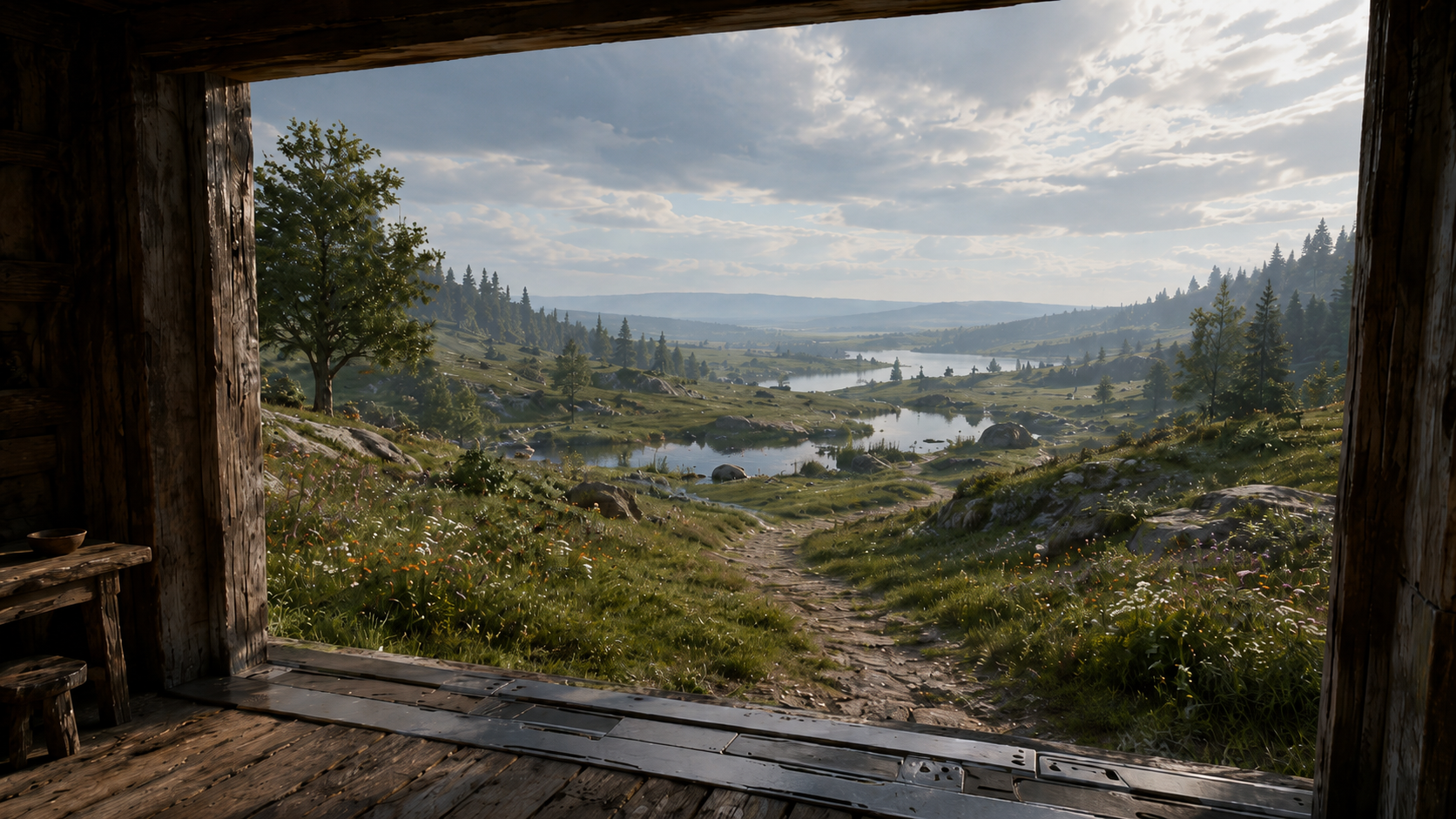
After the sealed corridors, dark chambers, technical rooms, encrypted apartments, and absence of windows, The Park gives the crew a form of open space. It is a field, a forest, a sky, a horizon. It offers wind, grass, water, animals, trees, and distance. Its purpose is not operational in the same sense as the Commanding Center or the Research Center. Its purpose is psychological, sensory, and existential. It allows a mind inside RT-874 to feel, for a time, that it is not enclosed inside a machine.
The Park is not a RUN, not a holodeck, and not a local simulation chamber. It belongs to the same level of reality as the rest of the ship. The visitor is not transferred into a separate virtual environment. The Park is a real space inside RT-874, even though its scale and behavior make that fact difficult to accept.
When someone enters The Park, they always begin at the same location: a wooden cabin connected to the internal transport system. This cabin functions as the fixed entry and return point. From there, the landscape opens into a vast natural environment that appears physically continuous and effectively infinite.
The Park is procedurally generated, but not randomly regenerated. Its geography has continuity. If a river exists in a certain place, it remains there when the visitor returns. If there is a lake, hill, grove, path, or unusual tree, that feature persists. The system may generate immeasurable extension and high complexity, but it does not shuffle the world between visits.
The general biome remains stable. The Park does not become desert, snowfield, beach, jungle, or tundra according to whim. It is primarily a green natural environment: fields, trees, rivers, lakes, paths, insects, animals, flowers, and sky. It may vary in detail, but not in fundamental identity.
There are no people in The Park.
Its fauna and flora are inspired by ancient human nature, but not as direct taxonomic reconstructions. The designers or artists who shaped the environment used human ancestral nature as a reference and then took artistic liberties. A contemporary human placed inside The Park would recognize categories: this is a forest, this is a bird, this is a snake, this is a flower, this is a tree. But such a person would not be able to catalog the species with certainty. The forms are familiar in function and impression, not exact biological copies.
Mike does not have the taxonomic knowledge of contemporary humanity required to judge whether the species are accurate or inaccurate. That is not his perspective. He perceives the place more broadly: it feels like a natural environment inspired by humanity’s ancestral world. It resembles the kind of nature humans once described, inhabited, feared, and loved. He can understand its intended feeling without being able to verify its biological fidelity.
The climate, light, and apparent time of day are adaptive. They respond to the will, state, or desire of the visitor. One person may experience The Park under a calm afternoon sky. Another, standing in the same region, may experience night. A third may perceive mist, rain, dawn, or a clear windless morning. Even if two visitors occupy the same area at the same time, each may perceive different atmospheric conditions.
This does not make The Park a RUN. The geography remains real and shared. The river is the river. The hill is the hill. The path is the path. But the experiential layer of weather, light, and time can be personalized. The Park does not merely contain nature. It adjusts the feeling of nature to the consciousness inside it.
Leaving The Park can happen in two ways. The visitor can return physically to the wooden cabin and use the transport system, or the visitor can simply desire to leave. The system detects the intention and returns the person to the cabin. From there, the visitor can decide whether to exit the level or continue.
This makes The Park one of the clearest examples of syraki design philosophy aboard RT-874. It does not require crude controls when intention can be read. It does not merely provide a room when a landscape can serve the mind better. It does not simulate comfort as decoration. It engineers relief through space.
Yet The Park is not fully comforting. Its beauty is too large for the ship that contains it. Its horizon should not fit inside RT-874. Its rivers, animals, trees, and sky imply an outside where there should be only the sealed body of the omniship. It exists to relieve claustrophobia, but its existence produces another kind of unease.
The Park offers openness inside enclosure.
It gives Mike the feeling of escape without proving that escape is possible.
3.6 Fifth Level - The Burrow
3.6.1 Image
3.6.2 Content
The Fifth Level of the RT-874 is known as The Burrow.
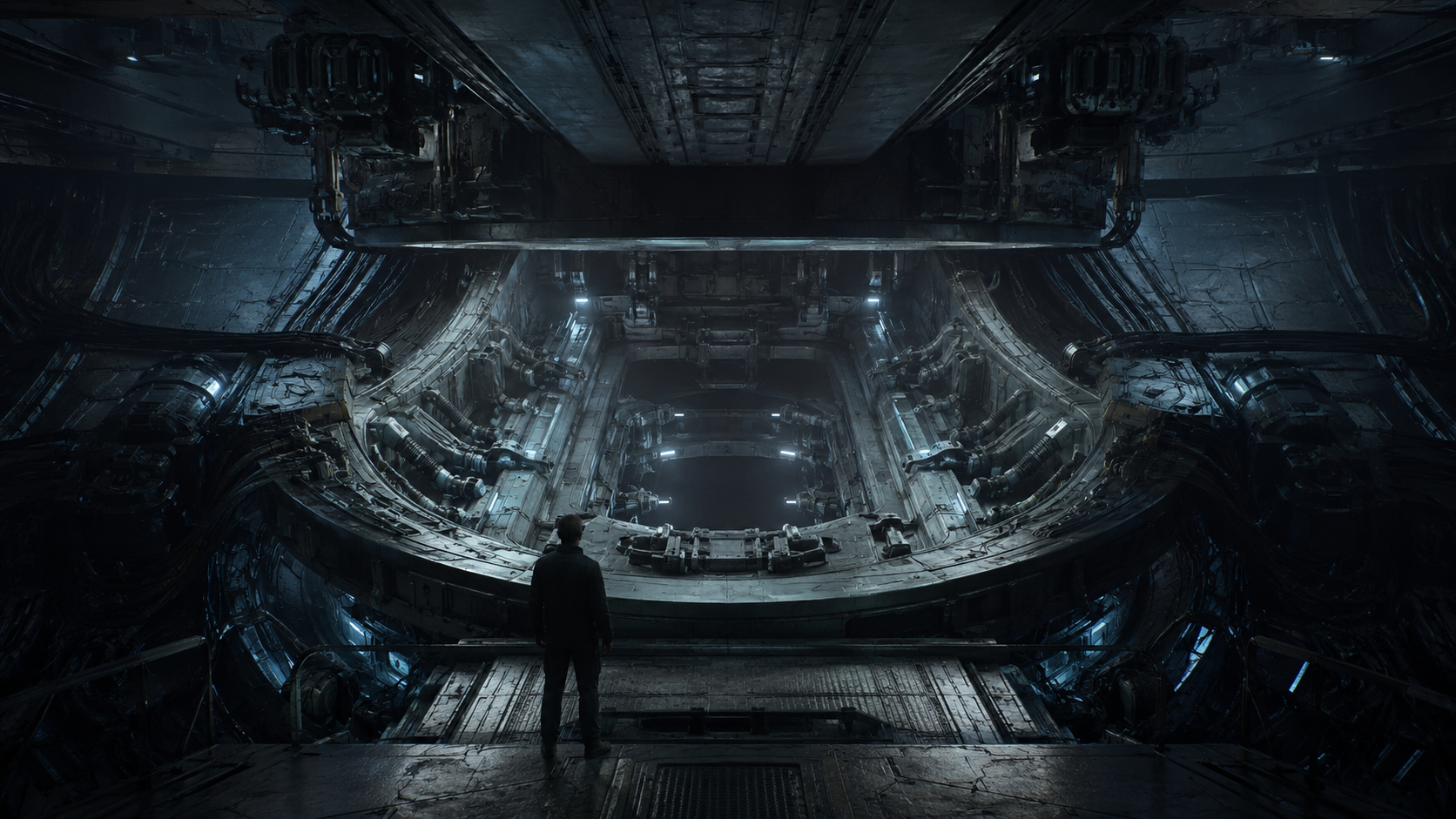
It is the lowest operational level of the omniship and one of the least hospitable spaces aboard. Unlike the Park, the Crew Apartments, or the Bridge, the Burrow was not designed arozund perception, comfort, command, or social continuity. It is a technical cavity built into the lower body of the vessel: a recessed chamber of launch systems, maintenance locks, power umbilicals, structural anchors, and localized navigation interfaces. It does not feel like a room inside a ship. It feels like something dug into the ship's underside and lined with machinery.
The Burrow exists for one primary reason: the storage, maintenance, launch, and recovery of the ZF-78, the auxiliary craft attached to the RT-874.
The Burrow's architecture reflects that role. Its central space is built around the ZF-78's cradle: a recessed docking bed surrounded by power conduits, locking arms, diagnostic ribs, coupling sockets, and launch rails. When occupied, the ZF-78 rests there like a blade held inside a sheath. When empty, the space becomes conspicuously wrong. The chamber appears designed around a missing object, and every cable, socket, and anchor points toward the absence.
The sensory character of the Burrow should be colder, lower, and more mechanical than the upper levels. Blue and silver alloy surfaces emit a dim technical glow. Nanotechnological nodes pulse along the walls like dormant circuitry. Cables run from terminal banks into the central docking area, resembling veins feeding an absent organ. The air carries less of the cultivated neutrality found elsewhere in the ship and more of a dry metallic stillness. Sound behaves differently here. Footsteps feel smaller. System hums seem buried behind the walls rather than distributed through them.
When Mike reaches the Burrow, the most important fact is simple: the ZF-78 is not there.
The absence should not read as a generic missing vehicle. It should feel like the removal of a vital instrument. The RT-874 possesses a lower cavity specifically designed to hold and operate its auxiliary craft, but the cradle is empty. The systems remain. The chamber remembers the craft. The ship has a socket, but no blade.
Narratively, the Burrow is the first level where absence becomes material. Elsewhere aboard the RT-874, Mike encounters missing people, sealed rooms, restricted systems, lost continuity, and partial information. In the Burrow, absence has mass and geometry. Something that should be physically present is gone, and the architecture itself testifies to that loss.
The level should therefore produce a sense of buried consequence. It is not frightening because it contains a monster or an immediate threat. It is frightening because it proves that, after the crash, someone or something used the RT-874's smallest and most specialized extension. The ship's local hand has already reached outward. Mike arrives only after the gesture has vanished.
4. Reason For The Name
...
5. Other Names
...
6. Population
...