Syraki Spaceships
Template: Note
Source: .writer/books/4. 💽 Database/3. 🗒️ Notes/Technology/Space Travel/Syraki Spaceships.org
1. Image
2. Content
The word spaceship is a human approximation for a broad family of syraki vessels. The syrakis themselves do not think of these machines through human naval or aerospace categories, but terms such as spaceship, spacecraft, starship, and vessel are useful translations. In general, a syraki spaceship is not a crewed vehicle in the human sense. It is a machine designed for movement, work, observation, transport, defense, construction, mining, relay support, exploration, or long-duration expansion within the physical universe.
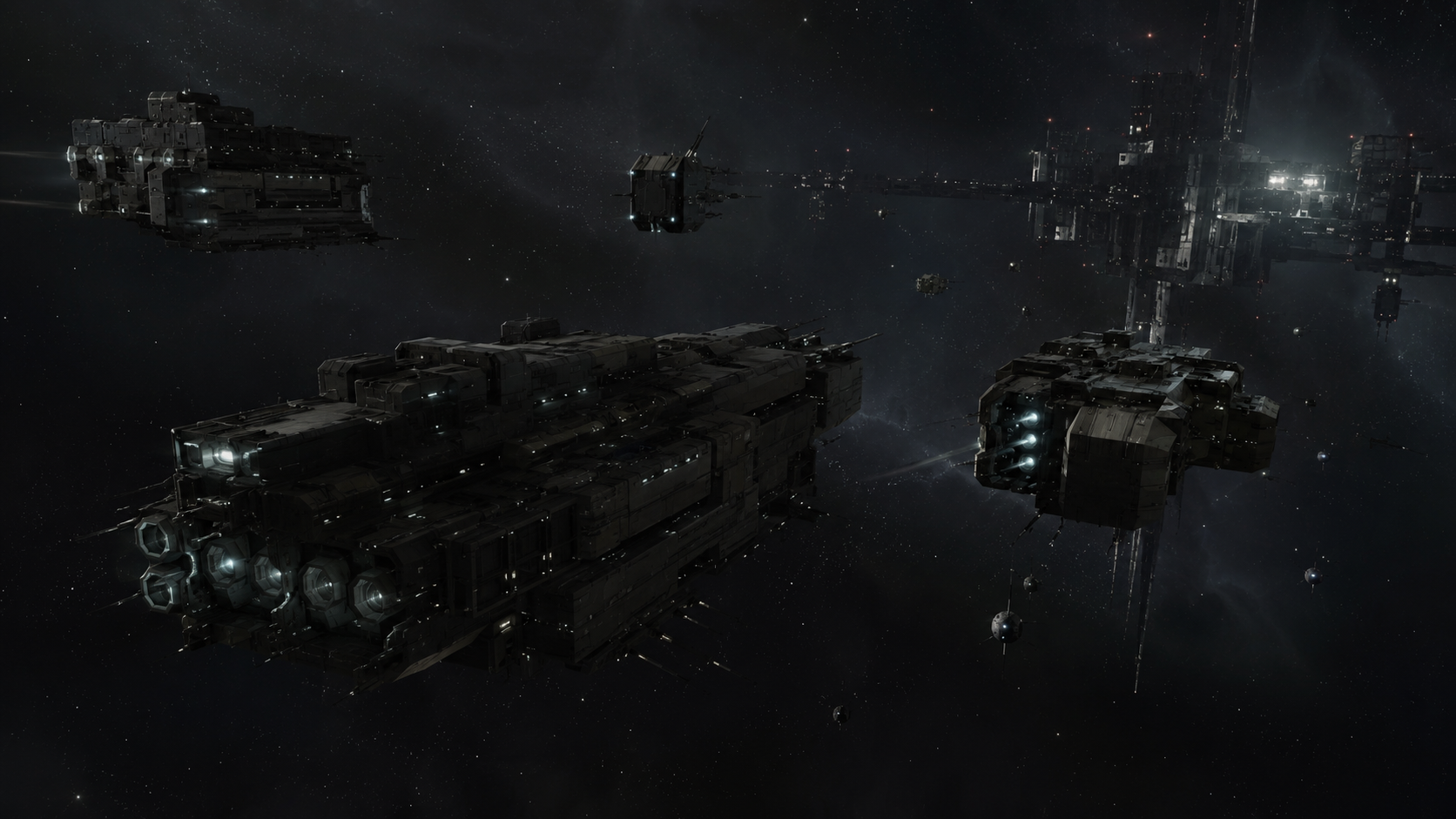
Most syraki spaceships are autonomous. They operate without syrakis aboard, relying instead on artificial intelligence, nenthors, specialized control systems, navigation algorithms, maintenance routines, and mission-specific automation. From the outside, many of these vessels would look less like human starships and more like brutalist drones: dense, opaque, functional machines with no visible concern for biological comfort. They are not built around windows, bridges, chairs, corridors, cabins, mess halls, or human-style command decks. They are infrastructure in motion.
When a syraki is involved in the operation of an ordinary spaceship, that does not usually mean that the syraki is physically walking inside the vessel. A syraki is fundamentally a computational and quantum-emergent being, so its presence aboard a vessel is not equivalent to a biological pilot sitting in a cockpit. The syraki may exist as an active process integrated into the ship's systems, experiencing the vessel through sensorium, control fields, mission models, and expanded operational awareness. To pilot a ship, a syraki does not need a chair. It needs coherent access to the machine.
A cockpit can be simulated if necessary, especially inside a RUN or an interface environment, but this is usually an inferior or ornamental way to control a vessel. A syraki can process navigation, thrust, sensor feedback, structural stress, external threats, and internal maintenance through forms of awareness much wider than human perception. For this reason, a ship containing a syraki may look identical to a ship containing no syraki at all. The difference is not architectural. It is informational, operational, and subjective.
Some vessels do use internal robotic bodies, physical avatars, or more traditional embodied arrangements. These cases exist for specific contexts: maintenance, interaction with physical artifacts, ritual functions, hazardous work, experimental constraints, social preference, or missions where localized embodiment is useful. Even then, the body is not the essence of the syraki's presence. It is a tool. The real participation of the syraki remains the continuity of its conscious process and its integration with the vessel's computational architecture.
There are two major ways for a syraki to participate in an ordinary spaceship: relay-connected operation and onboard hosting. In relay-connected operation, the syraki remains hosted elsewhere, often within the Complex or a corporate computational site, while controlling or inhabiting the vessel through a relay connection. If the relay is stable, the subjective and operational difference between being remote and being "inside" the ship may be small. The vessel becomes an extension of the syraki's perception and intention, even though the syraki's core continuity is not physically hosted inside the ship.
Relay-connected ships are practical only within certain limits. Relays use technology related to the same broad family as IG-Bridges, but they are not equivalent to full intragalactic bridges. A relay can maintain a connection to a moving object, but doing so requires constant calculation, stabilization, energy, and infrastructure. For simple routes, predictable trajectories, and controlled regions, this may be manageable. As distance increases, motion becomes more complex, or the ship moves beyond efficient support, the cost rises sharply.
Eventually, relay operation becomes impossible or impractical. A stronger relay can extend the range, but beyond a certain point the infrastructure begins to approach the scale and expense of a much more serious bridge system. A syraki cannot simply control a vessel remotely forever while it travels deeper and deeper into interstellar distance. The farther the ship moves from its support architecture, the more expensive and unstable the connection becomes, until the relay fails or must be deliberately severed.
For this reason, long-distance syraki travel often requires onboard hosting. In this model, the servers, computational substrate, and machinery necessary to sustain the syraki are placed inside the vessel. The ship becomes autonomous not only as a machine, but as a local host for conscious continuity. Once disconnected from the Complex, such a vessel may operate like a rogue or independent unit. It can travel far beyond normal relay range, pursue long-duration missions, and preserve the syraki aboard without relying on continuous external connection.
This autonomy carries severe risk. The Complex provides redundancy, stability, backup infrastructure, repair, monitoring, and civilizational protection. A syraki who leaves that structure is not forbidden from doing so, because syrakis are not slaves of the Complex. There are protocols for departure, and voluntary disconnection is possible. However, disconnection means accepting the danger that the ship may become the only active support for that syraki's continuity. If the vessel is destroyed, the original syraki may be lost.
Ordinary backups do not solve this problem. A syraki is not merely the computer hardware or the executable program that describes it. The program and substrate generate and maintain a highly sensitive quantum-emergent conscious state. That state, not the file alone, is the living syraki. If the original continuity collapses, restoring a backup may create a similar being, perhaps even one with the same memories and personality structure, but it does not guarantee survival of the same subjective experiencer. A backup can preserve information. It cannot automatically preserve the original "I."
This is why active continuity matters so much. A syraki cannot be casually split between a ship and a remote location. Safety protocols require the active conscious state to be either fully remote or fully hosted aboard. Dividing the active state across two locations would risk loss of quantum cohesion. If part of the system were in the ship and part remained elsewhere, a relay failure could destroy the emergent continuity altogether. To prevent this, ordinary spacecraft operation forbids partial conscious partitioning in normal circumstances.
Thus, a relay-controlled vessel and an onboard-hosted vessel may feel similar while both are functioning properly, but their risks are radically different. If a remote relay fails, the syraki may lose the ship but remain safe in the Complex. If an onboard-hosted vessel is destroyed beyond redundancy range, the syraki may die in the deeper sense: not merely lose a body, but lose the quantum continuity that made it that specific being. This makes long-duration independent travel a real act of exposure.
Syraki spaceships therefore express the broader nature of the civilization. They are powerful but not magical, automated but not trivial, distributed but still constrained by physics, energy, computation, and continuity. Most of them are machines without passengers. Some are extensions of distant minds. Some carry conscious beings into real danger. To a human observer, they may all look like silent brutalist drones moving through the dark. The difference lies in what kind of mind, if any, is bound to the machine.