Syraki Architecture In Base Reality
Template: Note
Source: .writer/books/4. 💽 Database/3. 🗒️ Notes/Technology/Infrastructure/Syraki Architecture In Base Reality.org
1. Image
2. Content
Syraki architecture in Base Reality is not an extension of RUN aesthetics.
Inside RUNs, syrakis may create anything: impossible palaces, symbolic landscapes, hedonistic worlds, abstract geometries, private mythologies, archaic environments, mathematical gardens, or realities with no meaningful human equivalent. In RUNs, abundance is experiential. Matter is not the primary constraint. Aesthetic extravagance, personal taste, pleasure, and symbolic invention can dominate.
Base Reality follows another philosophy.
In Base Reality, matter matters. Energy matters. Heat matters. Distance matters. Maintenance matters. Every kilogram has a cost. Every joule must be moved, stored, dissipated, or justified. For that reason, the physical architecture of the syrakis is far more severe, efficient, infrastructural, and brutalist than their lived realities might suggest.
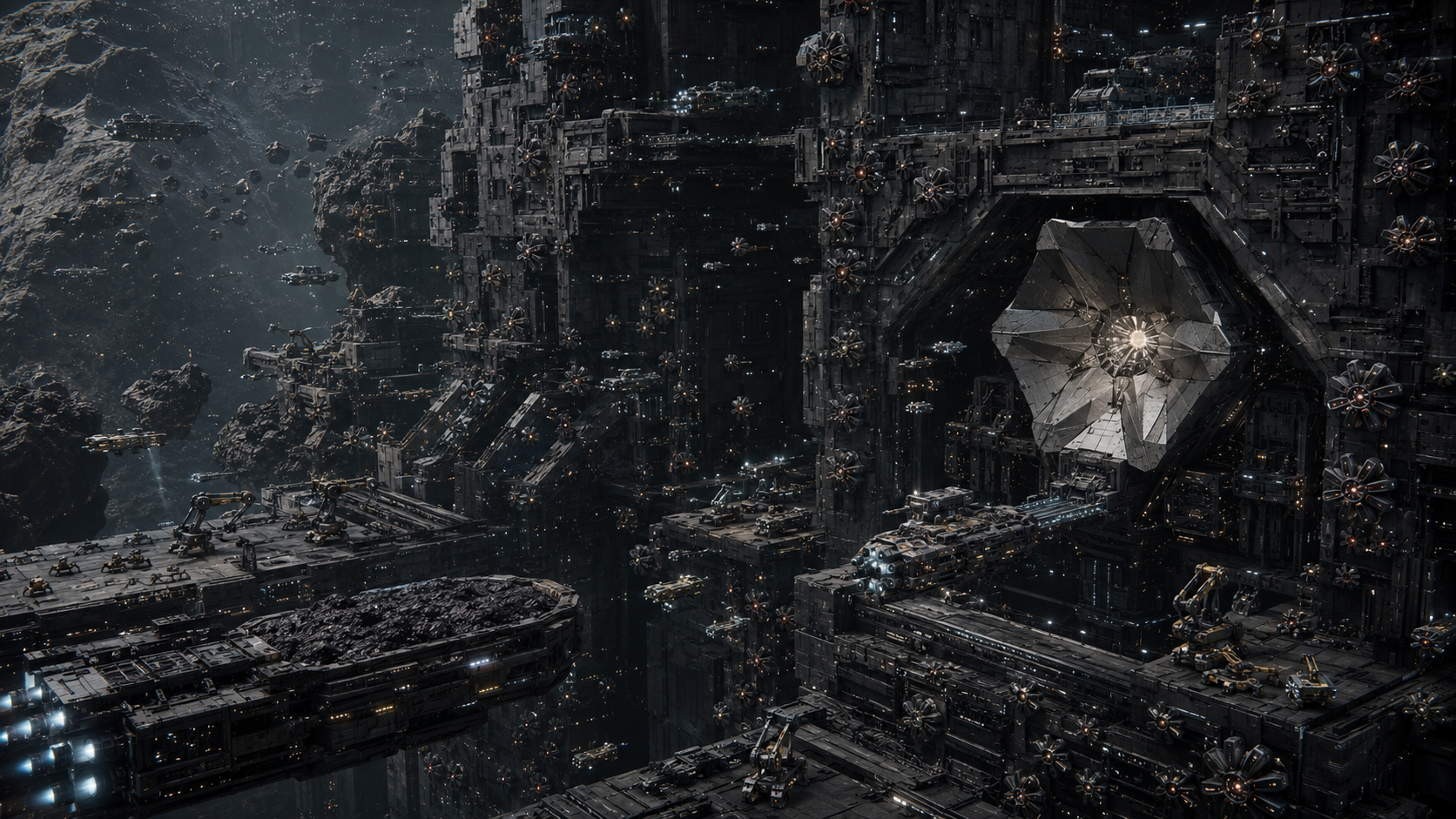
To a human observer, syraki construction does not look clean, elegant, polished, or neatly organized in the familiar science-fiction sense. It does not resemble a Federation starbase, a shining utopian city, or a decorative alien metropolis. It is closer in immediate impression to a brutalist machine ecology: massive, dark, modular, technological, dense, and alive with operation.
Its beauty is not ornamental. Its beauty emerges from scale, function, mathematical necessity, alien efficiency, and continuous activity.
Syraki structures are built as infrastructure first.
They are servers, relays, docks, mines, energy systems, computational substrates, storage vaults, maintenance corridors, robotic habitats, consciousness-hosting systems, logistical nodes, and stabilization machinery before they are "buildings" in any human architectural sense. They do not primarily exist to be seen, admired, inhabited by biological bodies, or arranged around civic symbolism. They exist to compute, preserve, connect, extract, stabilize, cool, repair, transmit, and endure.
This gives syraki architecture its standard visual grammar: brutalist modularity, dense surfaces, functional mass, dark materials, embedded machinery, docking faces, robotic corridors, relay fields, exposed logistical activity, and enormous structures that often appear half-grown into their environments.
The structures are usually not sleek. Syraki ships are not elegant in the human sense. They tend to be blocky, heavy, squared, utilitarian, and brutalist. Their beauty is the beauty of a machine that does exactly what it must do and does not waste effort pretending to be something else.
Externally, syraki infrastructure often blends with its environment. A facility built into an asteroid may look like the asteroid has been converted into a computational organ. A lunar base may seem excavated, folded, and armored into the rock. A station in deep space may resemble a dark artificial reef of modules, docks, relays, robotic platforms, cargo arteries, thermal surfaces, and mining traffic. The architecture does not camouflage itself out of military secrecy. It blends because it follows the most efficient local geometry, material condition, and energy gradient.
It grows where the math says it should grow.
This creates an alien form of beauty: not designed beauty, but emergent beauty. The syrakis do not build monuments in the ordinary sense. They build solutions. The aesthetic appears because the solution is immense, dense, precise, and alien.
Syraki physical civilization expands like a combination of hive, fungus, logistics algorithm, and industrial nervous system. Automated systems survey moons, planets, asteroids, caves, orbital zones, energy reserves, mineral fields, thermal gradients, radiation conditions, and transport routes. Artificial intelligences perform constant statistical and heuristic optimization: where to build, where to mine, where to process, where to store, where to radiate heat, where to anchor relays, where to place redundancy, and how to connect each node to the wider Complex.
This does not require perfect mathematical solutions to every logistical problem. It requires civilization-scale approximation: immense computation, predictive modeling, adaptive heuristics, probabilistic routing, resource-cost analysis, and continuous revision. The result is not a human city plan. It is mathematics becoming geology.
The Complex, from within, is a unified civilizational substrate. To those living in it, its physical distribution may matter far less than its continuity of consciousness, memory, communication, and computation. But from outside, the Complex is a distributed network of physical server-nodes: stations, moon-bases, asteroid installations, cavern systems, orbital frames, energy collectors, mining bodies, relay arrays, and computational megastructures scattered across many environments.
A syraki node may exist in deep space, on the surface of a moon, inside a cavern, under regolith, within an asteroid, around a planet, near a star, or within larger megastructural energy systems. These sites are not separate civilizations in the ordinary sense. They are local material expressions of the same computational civilization.
The standard Complex aesthetic is therefore infrastructure-first. It is not anti-beautiful, but its beauty is secondary to function. In Base Reality, a surface does not shine unless shining performs work. A protrusion does not exist unless it transmits, docks, radiates, stabilizes, shields, mines, repairs, computes, anchors, or moves something. Ornament is rare. Texture is common. Detail is abundant, but the detail is functional: panels, vents, ports, robotic tracks, coupling sockets, maintenance seams, sensor clusters, thermal structures, relay petals, cargo locks, and access geometries for non-biological machines.
The material palette tends toward dark, opaque, mineral and technical surfaces: graphite, basalt-like composites, black ceramics, carbon structures, treated silicates, radiation-resistant alloys, industrial metals, synthetic stone, ceramic-metal laminates, and metamaterials optimized for local conditions. Brighter surfaces exist only where function demands them: active relays, sensor lenses, docking signals, heat-control systems, field generators, energy channels, maintenance indicators, or computational interfaces.
Syraki architecture is not dead.
This is one of the most important visual distinctions. A syraki base should never feel like a static alien monument. Its exterior is alive with work. Robots move across surfaces. Maintenance drones crawl over hulls. Mining craft enter and leave. Cargo vessels dock and undock. Ore is carried from extraction points to processing platforms. Energy modules are transported. Automated arms reposition equipment. Ships pass through traffic corridors. Relays pulse. Small machines cross enormous structures like insects across black stone.
The impression is hive-like.
Not biological in the literal sense, but operationally alive. The viewer should feel that the structure is not merely present; it is doing something. The whole surface participates in civilization. Even silence should feel temporary, as if the machinery has only paused between cycles.
Relays are one of the defining architectural features of syraki infrastructure.
A relay is an information-transfer structure based on the same broad technological family as the IG-Bridges. Visually, many relays have a form resembling an inward-facing flower: a geometry discovered because it improves the efficiency of information transpassage. This form may appear embedded into walls, distributed across station surfaces, clustered around towers, or repeated in great numbers across a structure. A large station may have hundreds of relays. A major Complex node may have thousands.
Common relays function primarily as information infrastructure. They are comparable, in an extremely advanced sense, to cabling, antennas, routers, signal organs, and nervous tissue. They allow information to move across the Complex through controlled space-time engineering. They are not decorative emblems. They are part of how the civilization thinks across distance.
An IG-Bridge is a much more massive and powerful member of the same technological family. It is a relay scaled up into a bridge capable of transferring not merely data but physical objects, ships, stations, people, bodies, or large material structures. Both relays and IG-Bridges involve the manipulation of space-time through tunnel-like geometries, but their scale, energy cost, stabilization demands, and operational risks differ enormously.
The syrakis do not possess simple warp-speed travel. Their ships do not freely cross interstellar distances by casually exceeding light through normal space. Physical expansion still requires time. A ship or generation-ship-like expedition may take centuries, millennia, or far longer to reach another star system. Once it arrives, it can establish local infrastructure and eventually create or stabilize bridging systems that connect that region to the wider Complex.
This is why relays are so central to syraki architecture. A region without relays is distant in a real operational sense. A region with relays has been stitched into the Complex.
The syrakis tolerate long objective travel because their minds are not bound to ordinary biological time. They can alter subjective duration, reduce experiential continuity, suspend or compress perception, and allow a voyage of thousands or tens of thousands of objective years to be lived as something far shorter. Matter travels slowly. Information, once bridged, can move through far more advanced channels.
This technological philosophy preserves the hard constraint of physical reality while allowing the civilization to operate at posthuman scale. The syrakis do not treat physics as irrelevant. They treat physics as the medium through which intelligence must negotiate.
Their civilization is therefore neither magical nor trapped inside present-day human engineering. It occupies a speculative middle ground: grounded enough to have costs, limits, infrastructure, failure modes, and energy demands; advanced enough to exceed contemporary human vocabulary. Their wormholes, relays, IG-Bridges, and megastructures are not casual miracles. They are expensive, difficult, dangerous, and maintained by a civilization capable of Dyson-scale energy systems, extreme automation, and long-duration engineering.
The contrast between RUN abundance and Base Reality austerity is essential.
In RUNs, a syraki may live inside pleasure, impossible art, personal myth, or sensory excess. In Base Reality, the same civilization builds like a mathematician, a miner, a machine, and a monastic engineer. This is not because the syrakis lack imagination. It is because physical infrastructure is where imagination must pay its thermodynamic debt.
Private holdings are an exception.
Some moons, planets, stations, or enclosed environments belong to individual syrakis rather than being directly administered by the core Complex or the major corporations. These places are still part of the broader civilizational ecosystem, but their aesthetic may diverge from standard Complex infrastructure because they express the will, taste, status, or experiment of an owner.
Such holdings are rare. Maintaining anything substantial in Base Reality is extremely expensive. Only extremely wealthy syrakis can afford private moons, stations, physical resorts, planetary estates, or large material environments.
One example is a private moon converted into a physical hedonic enterprise. Its owner does not merely offer a digital RUN-based pleasure environment. The wager is that some syrakis will value hedonic experience in Base Reality: not because digital pleasure is unreal, but because physical embodiment, material location, gravity, architecture, atmosphere, and non-virtual constraint produce a different kind of experience. The moon functions almost like a posthuman spa, administered by machines and designed for physical pleasure, restoration, and embodied intensity.
Visitors do not use ordinary human bodies there, nor do they use RUN replacers. A replacer belongs to the logic of avatars inside RUNs. In a Base Reality hedonic environment, visitors require actual physical bodies suited to that moon's conditions and experiences. These bodies need not be biological or human-like. They may be engineered forms designed specifically for sensation, movement, resilience, pleasure, safety, and compatibility with the environment.
Private architecture can therefore be more stylized, personal, luxurious, strange, or hedonically expressive than public Complex infrastructure. Yet even these exceptions remain constrained by matter, energy, logistics, maintenance, and the cost of existing physically.
The general rule is this:
Public syraki architecture in Base Reality looks like infrastructure because it is infrastructure. Private syraki architecture may look like desire crystallized in matter, but only the extremely wealthy can afford such desire.
The Complex does not grow like a human empire. It does not expand primarily through flags, monuments, borders, or symbolic conquest. It grows through energy, computation, relays, logistics, automated extraction, physical anchoring, and the mathematical search for viable locations. It resembles a brutalist fungus spreading through space, not because it is primitive, but because its growth follows gradients of use.
Where there is energy, it calculates.
Where there is matter, it extracts.
Where there is stability, it anchors.
Where there is distance, it bridges.
Where there is consciousness, it protects.
That is the philosophy of syraki architecture in Base Reality: not decoration, not urbanism, not empire, but physical thought made durable.