Alien Life Alien Civilizations And The Syraki Posture Toward The Cosmos
Template: Note
Source: .writer/books/4. 💽 Database/3. 🗒️ Notes/Species/Alien Life Alien Civilizations And The Syraki Posture Toward The Cosmos.org
1. Image
2. Content
Alien life is real in the universe of Brain's Cage.
The syrakis are not a civilization trapped inside the ancient human uncertainty of whether life exists beyond one planet. They have spread across hundreds, perhaps more than a thousand connected star systems, with peripheral sites, private stations, research outposts, ruins, probes, and partially connected structures scattered through a wider galactic region. At that scale, and across the immense age of their civilization, the discovery of alien life is not exceptional in itself.
What remains exceptional is intelligence, civilization, and contact.
The syrakis have found many forms of non-syraki life. Biosphere-bearing planets are known to them. They have encountered alien fauna, alien flora, microbial life, viral life, bacterial analogues, asteroid-based life, and non-Earthlike biological systems that do not fit simple carbon-based human expectations. Some of these biospheres are strange by human standards, but not mysterious enough to destabilize syraki science. They are catalogued, studied, modeled, preserved, and folded into the larger body of xenobiological knowledge.
Life is not rare enough to be sacred merely because it exists.
It is, however, always ethically relevant.
The syrakis do not treat alien biospheres as empty resource fields. Their ethical science requires them to account for conscious experience, potential consciousness, suffering, ecological complexity, contamination risk, and the long-term value of preserving independent evolutionary systems. Even when the life encountered is not intelligent, the syrakis approach it through protocols of study, non-contamination, risk control, and minimal interference.
Their relationship with alien life is therefore scientific, ethical, and cautious, not romantic.
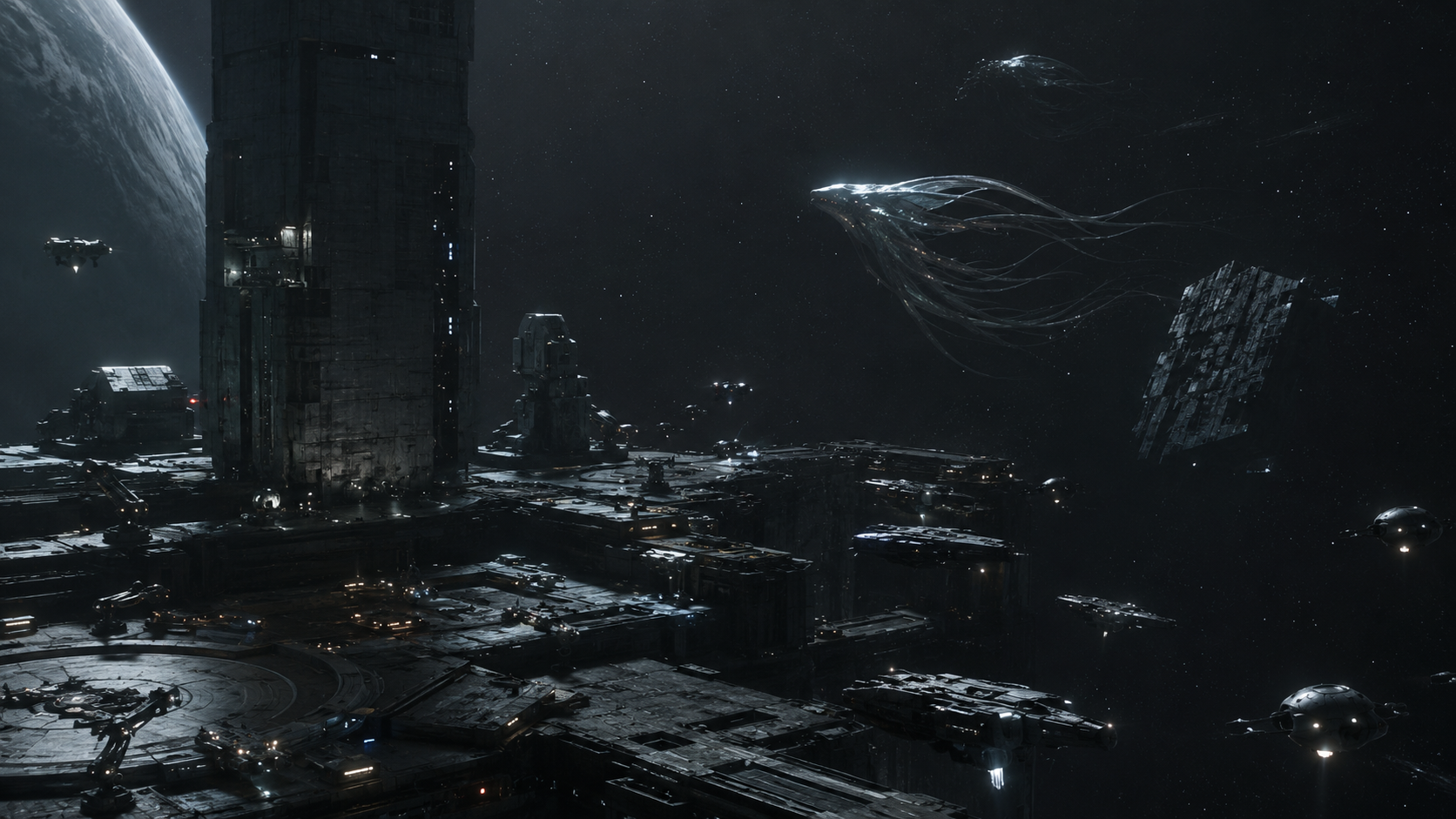
Among the most mysterious forms of life known to syraki biology are organisms that live directly in space. These range from microbial or bacterial-scale forms capable of surviving in vacuum or near-vacuum conditions to enormous space-dwelling organisms larger than spacecraft. These beings are sometimes informally treated as "space beasts," though the term should not reduce them to monsters. They are native forms of cosmic biology: difficult to classify, difficult to track, and often poorly understood even by syraki science.
Some space-dwelling organisms are harmless. Others are dangerous.
Very rarely, one of these organisms may detect the energy signature of a syraki base, relay, station, or industrial node and approach it as an animal might approach light, heat, food, or a territorial stimulus. In the past, such events have damaged or even destroyed syraki infrastructure. These incidents are rare, but the possibility is taken seriously.
The syraki response follows their ethical hierarchy.
First, they attempt to divert the organism. Decoys, false emissions, bait, altered energy signatures, repulsion fields, controlled lures, and non-lethal redirection may be used. If the organism can be moved away from the base without harm, that is preferred. If study is necessary, capture may occur, but only under strict protocols and with respect for the possibility of suffering or conscious experience.
If the organism continues to attack and threatens conscious beings or critical infrastructure, the syrakis defend themselves.
They do not hunt these beings for spectacle. They do not kill them out of disgust or fear. But they are not pacifists. A station, relay, or inhabited substrate cannot be sacrificed to an organism simply because the organism is natural. If lethal action becomes necessary, the response is decisive: usually an energy weapon, laser system, or comparable defensive mechanism designed to end the threat quickly.
The syrakis also maintain models for more extreme possibilities. They have never encountered a space-dwelling organism of truly catastrophic scale, something comparable to a mythic cosmic leviathan capable of threatening major Complex infrastructure, but the possibility exists in their strategic imagination. This is not human superstition. It is risk modeling. They know enough about the universe to understand that absence of evidence is not proof of safety.
The syrakis have also found alien ruins.
These discoveries include remains of primitive civilizations, ancient settlements, city ruins, markings analogous to cave paintings, and traces of extinct cultures. They have also found more advanced artifacts, including fragments of alien vessels drifting through space long after some unknown destruction, explosion, or abandonment. Such discoveries are rare but not singular. They form part of the xenoarchaeological background of syraki civilization.
The syraki treatment of alien ruins is cautious and preservational.
There are protocols for ruins, artifacts, dead civilizations, anomalous structures, unknown technologies, and possible information hazards. The theoretical risk of information hazard is always present. A dead civilization may have built dangerous systems. An alien artifact may contain hostile logic, unstable technology, memetic structure, harmful computation, or unknown causal consequences. So far, no known alien ruin has produced an information hazard comparable to the deepest threats faced elsewhere in syraki history, but the possibility is never dismissed.
When the syrakis find ruins, they do not loot them.
They study what can be studied while altering as little as possible. If a site is important, they may build nearby infrastructure: research stations, robotic survey systems, containment shells, observation platforms, relay-limited outposts, or long-term analytical installations. Expeditions to such places do exist, but they are not human-style archaeological adventures. They are usually conducted by automated systems, robotic bodies, specialized research intelligences, controlled probes, and highly restricted interfaces.
There are syrakis who are deeply fascinated by alien civilizations.
This fascination exists both formally and culturally. Xenoarchaeology, xenobiology, alien ruins, suspected civilizations, lost vessels, ancient markings, and unexplained structures are not merely technical topics. They also form part of syraki cultural imagination. There are professional researchers, enthusiasts, speculative communities, models, debates, private investigations, aesthetic movements, and cultural fascination surrounding the question of alien minds.
This should not be confused with human UFO folklore.
Syraki speculation is posthuman, statistically informed, historically deep, and technologically sophisticated. But it is still culture. It still contains fascination, suspicion, projection, curiosity, and mythic pressure. When Mike, lost in the desert at the beginning of the novel, considers the possibility that he may have been abducted or placed there by an alien civilization, that suspicion reflects a real category within syraki thought. The idea is not childish to them. It is unlikely, dangerous, modelable, and culturally available.
The syrakis have not made open contact with a living alien civilization.
They may suspect the existence of active civilizations elsewhere in the galaxy. They may have mapped regions where statistical models suggest technological life is likely. They may infer possible civilizations from energy patterns, astronomical anomalies, artifact distribution, ecological probability, unexplained structures, or long-distance observations. But these regions are far away, and the syrakis do not possess simple warp-speed travel. Reaching them would require long physical expansion, infrastructure, risk, and civilizational decision.
Their posture is therefore not contact-seeking.
It is observation without exposure.
The syrakis prefer to observe from a distance, like someone studying through binoculars rather than walking toward the unknown light. They collect what can be collected. They model what can be modeled. They study patterns, probabilities, risks, signatures, and possible histories. But they do not broadcast themselves recklessly. They do not send signals into the galaxy in the naive hope that whoever answers will be friendly. They do not treat first contact as a romantic destiny.
Their policy is shaped by survival.
The Central Algorithm and wider syraki civilization understand that the universe may contain dangers far beyond ordinary biological threat. An alien civilization could be benevolent, indifferent, predatory, incomprehensible, unstable, contagious in an informational sense, or ethically incompatible in ways that cannot be negotiated after exposure. The danger of first contact is not that aliens must be evil. The danger is that one does not know what they are until contact has already occurred.
For this reason, syraki infrastructure is built with concealment in mind.
Bases mask emissions. Radiation signatures are controlled. Heat and energy profiles are managed. Traffic is routed carefully. Relay exposure is minimized. Detection-containment protocols exist. If one base is discovered, it should not reveal the positions of other nodes. No single detected station should become a map of the Complex. First-contact protocols exist, but they are not casual diplomatic rituals. They are survival structures.
The syrakis are curious, but they are not exhibitionists.
They do not avoid knowing. They avoid being seen knowing.
This discretion also affects how they think about diplomacy. Syraki diplomacy is not based on emotional persuasion in the human sense. Their ethics is not cosmetic philosophy; it is a central civilizational science. It shapes politics, governance, risk assessment, contact policy, suffering minimization, and strategic behavior. If confronted by another civilization, the syrakis would listen to evidence, models, arguments, and ethical claims. They would not be swayed by pleading, theatrical emotion, honor rhetoric, or sentimental appeal.
This makes them appear cold.
The coldness is real, but it is not malice.
If an alien civilization attempted to dominate, extort, or threaten them, the syrakis would not automatically respond with pride or defiance. They would calculate. They would estimate survival probability, autonomy loss, expected suffering, strategic reversibility, ethical damage, long-term risk, and the cost of resistance. If tribute, concession, delay, or partial submission preserved more consciousness and freedom in the long term than immediate war, they might accept it temporarily.
If domination crossed intolerable thresholds, they would resist.
If an enemy demanded access to the Complex, manipulation of consciousness, systemic coercion, creation of suffering, irreversible control, or anything that threatened the ethical foundation of syraki existence, the response could become absolute. They are not proud in the human sense, but they are not cowardly. They can yield when yielding preserves possibility. They can fight to extinction when survival would mean becoming something ethically unacceptable.
This same ethical coldness appears in the single known case of planetary destruction.
The syrakis once encountered a planet whose evolved life-system produced extreme, systemic, intolerable suffering. The ecosystem was not a simple evolutionary failure. In its own terms, it had succeeded. But what it had produced was a stable biological or quasi-biological order built around suffering at a level the syrakis judged ethically unacceptable. They investigated possible mitigation, alteration, rescue, preservation, and transformation. The damage was too deep.
They sterilized the planet.
They did not destroy it theatrically. They did not shatter it with a weapon for spectacle. They carried out a controlled intervention that eliminated the life-system and desertified the world. The life there was not necessarily Earthlike or carbon-based. The point was not taxonomy. The point was suffering.
The syrakis do not regard this event with shame.
They do not treat it as a cultural crime, scandal, or trauma. The Infernal Wars are shameful and traumatic because they involved the artificial creation of suffering, hells, coercion, and ethical collapse. The sterilized planet belongs to a different category. To the syrakis, it was a severe but rational intervention that ended an intolerable natural structure of suffering. Some may regard it with solemnity, but not with guilt. It is remembered as an example of ethics carried to its necessary conclusion.
This distinction is essential.
The syrakis do not worship life as an absolute value. They value conscious experience, freedom, suffering minimization, consent, stability, and the protection of minds. Life that produces intolerable suffering without viable remedy is not automatically sacred to them. A biosphere can be precious. It can also be a machine of agony.
This does not mean the syrakis casually destroy worlds.
Earth, for example, despite its suffering, violence, disease, predation, poverty, cruelty, and grief, would be far below the threshold of the exceptional planet they destroyed. The syrakis would not destroy Earth merely because suffering exists there. They would likely observe from afar, respect its native development, and avoid unnecessary interference. The destroyed planet represented another order of horror.
The alien question in the Complex should therefore remain layered.
Alien life is known.
Alien biospheres are real.
Space-dwelling organisms exist.
Ruins and artifacts have been found.
Living alien civilizations are suspected, modeled, and observed from great distance.
Open contact has not occurred.
The syrakis are curious, but discreet.
They are ethical, but cold.
They are powerful, but cautious.
They do not want to turn the galaxy into a multi-species empire. They do not seek a federation. They do not build cantinas of alien species inside the Complex. The alien presence in the setting should deepen the universe without changing the genre into space opera.
The central horror of *Brain's Cage* does not come from aliens.
That is precisely why the alien background is useful. The syrakis already know that life can be strange. They have seen alien ecologies, ruins, artifacts, space beasts, and dead civilizations. They have models for living civilizations far away. They have protocols for first contact, concealment, defense, preservation, and xenoarchaeology.
And still, what they encounter in the main story does not fit.
It is not merely alien life.
It is not merely another civilization.
It is something deeper in the structure of reality.
The existence of aliens expands the cosmos. The thing at the center of *Brain's Cage* breaks it.