The Scale And Distribution Of The Complex
Template: Note
Source: .writer/books/4. 💽 Database/3. 🗒️ Notes/Society/The Scale And Distribution Of The Complex.org
1. Image
2. Content
The Complex is not a single city, station, planet, empire, or centralized megastructure.
It is a distributed civilizational infrastructure spread across a region of the galaxy. Internally, to the syrakis who live within it, the Complex functions as one continuous computational civilization: a vast substrate of consciousness, memory, communication, simulation, governance, economy, pleasure, research, and existence. Externally, in Base Reality, it is not continuous in the ordinary spatial sense. It is made of physical nodes: stations, moons, asteroid installations, planetary bases, cavern systems, orbital frames, energy collectors, relay arrays, private holdings, mining bodies, storage vaults, and computational megastructures separated by enormous astronomical distances.
The Complex should not be imagined as a compact object.
It is a network.
Earlier conceptions may have imagined the Complex as spanning only a few solar systems, but the current scale is much larger. The Complex occupies many star systems across a defined galactic region. It is not multigalactic. It is not spread across the entire galaxy. It is not infinite. It has borders, cores, peripheries, abandoned or minor sites, semi-connected holdings, private nodes, dense systems, sparse systems, and regions beyond its practical reach.
A reasonable way to describe its scale is that it spans hundreds of star systems, perhaps more than a thousand directly connected systems, with several thousand additional peripheral, semi-connected, private, experimental, minor, abandoned, or loosely affiliated sites. This number does not need to be stated precisely in the novel. The important point is organic scale: the Complex is vast enough to be civilization-sized in a posthuman sense, but still small enough to remain a bounded island within a much larger galaxy.
Not every system in the Complex is equally important.
Some star systems are dense core systems, containing major computational infrastructure, heavy relay networks, energy extraction systems, administrative depth, large-scale consciousness hosting, extensive industrial automation, and deep integration with the Central Algorithm's stabilizing architecture.
Other systems are productive systems: optimized for mining, energy capture, storage, heat management, research, manufacturing, redundancy, or long-term civilizational maintenance.
Others are peripheral systems: lightly occupied, sparsely connected, experimental, observational, private, semi-autonomous, or maintained for strategic reasons.
Some systems contain only a few stations, a relay cluster, a moon-base, or a narrow industrial purpose. Others are crowded with traffic, robotics, docks, mines, computation stacks, and hundreds or thousands of relays.
This unevenness is essential.
The Complex does not spread like a human empire drawing borders on a map. It grows like a mathematical organism. It expands where energy, matter, safety, computation, route efficiency, relay geometry, thermal behavior, or strategic necessity make expansion worthwhile. Some systems become dense because they are useful. Others remain thin because they are only marginally valuable. The result is not uniform colonization. It is organic infrastructure.
From within, the Complex may feel unified.
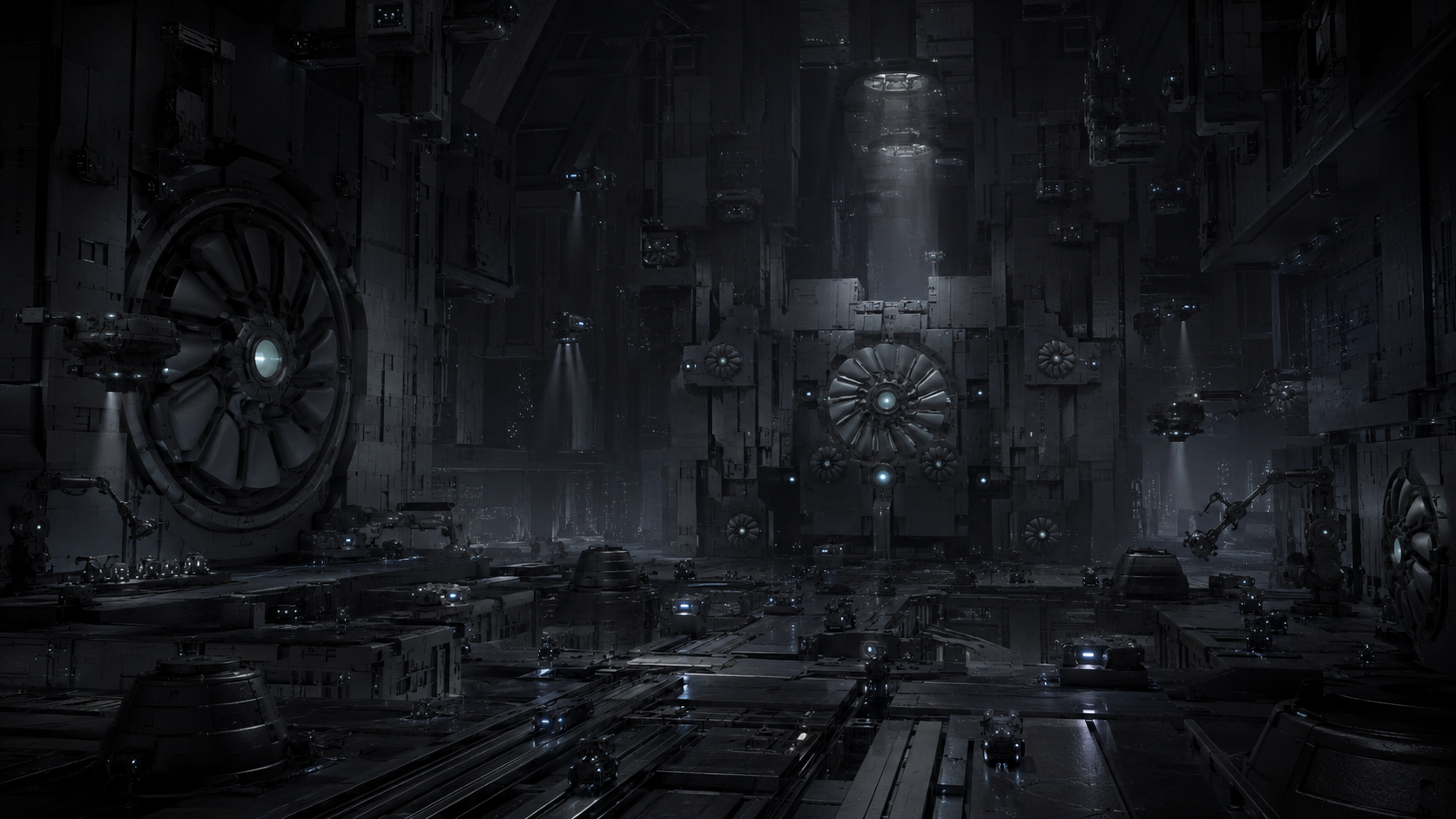
From outside, it resembles a brutalist fungus growing through space: dark, modular, machine-dense, and attached to whatever local conditions make sense. One part may be embedded inside a moon. Another may be hidden in an asteroid belt. Another may be built around energy collection near a star. Another may exist inside caves beneath a planetary crust. Another may be a station field suspended in cold space for thermal or computational reasons. All are different physical expressions of the same civilizational substrate.
The syrakis do not possess simple warp-speed travel.
Physical expansion still takes time. Ships, automated expeditions, and generation-ship-like missions must cross interstellar distances through slower physical means. A mission may take centuries, millennia, tens of thousands of years, or longer in objective time. This does not pose the same problem for syrakis that it would for biological humans. Syraki minds can alter subjective duration, compress experiential time, suspend continuity, or experience vast objective periods as something much shorter. A voyage lasting thousands of years may be lived as a short operational interval by the consciousnesses involved.
This means matter travels slowly, but civilization can tolerate slowness.
The decisive acceleration occurs only after infrastructure is established. Once a new system is reached, stabilized, secured, and bridged, it can become part of the wider Complex through relay and IG-Bridge systems.
The usual integration protocol for a new system follows three invariant priorities.
First: secure energy.
A new node cannot become part of the Complex without reliable energy. Usually this means establishing access to the local star through collectors, orbital infrastructure, or other energy-extraction systems. In special or closer contexts, an expedition may carry reserves such as antimatter or other high-density energy stores, but sustained integration requires a stable local energy flow. Without energy, no computation, construction, relay stabilization, security analysis, or long-term growth can proceed.
Second: verify security.
The Complex does not blindly open a bridge into itself. Before any full connection is established, the new system must be examined for threats, contamination risks, hostile conditions, anomalous phenomena, unknown activity, dangerous artifacts, biological hazards, informational hazards, unstable physics, or anything that might compromise the wider civilization. If a system fails safety protocols, it is not directly connected. The syrakis do not treat distance as a trivial inconvenience; they treat connection as exposure.
Third: establish stable communication and bridging.
Only after energy and security are secured can the system be connected to the wider Complex through relay or IG-Bridge infrastructure. This stage involves establishing communication, stabilizing the bridge, testing causal and informational integrity, confirming isolation protocols, and ensuring that the new node can communicate without endangering other nodes.
After these three stages, growth becomes organic.
There is no universal build order after integration. The intelligence managing the operation, whether a ship intelligence, local administrative system, corporate architecture, Central Algorithm-aligned process, or specialized construction intelligence, decides according to context. In one system, the optimal path may be star infrastructure first. In another, asteroid mining. In another, cavern-based computation. In another, thermal infrastructure. In another, relay redundancy. In another, distributed security. In another, low-emission hidden development.
The syrakis do not need a fixed "city plan" because their systems can evaluate local conditions at a level no human observer could reduce to a simple diagram.
A mature Complex system may contain energy cores, computation nodes, mining zones, storage bodies, relay networks, manufacturing fields, private territories, research stations, security shells, maintenance traffic, thermal structures, autonomous robotics, and administrative substrates. But a human observer would not necessarily be able to identify these functions by sight.
To human perception, a mature Complex system appears as an immense brutalist machine ecology: dark modular structures, relays, moving drones, ships docking and undocking, mining beams, cargo traffic, robotic arms, silent maintenance systems, and vast geometric masses half-grown into moons, asteroids, caves, and orbital frameworks. The true functional map belongs to syraki cognition and machine interpretation, not to human intuition.
This lack of legibility is important.
The Complex should not be described as if it were a human city with obvious districts: residential zone, industrial zone, palace, port, government center, entertainment district. Those categories do not map cleanly onto syraki Base Reality. Most syrakis do not physically inhabit these structures in the way humans inhabit cities. Their lived existence occurs primarily within RUNs and other computational environments. Base Reality is the material skeleton that makes such existence possible.
Therefore, the external Complex is not domestic.
It is infrastructural.
Its physical nodes are optimized for computation, preservation, energy extraction, security, redundancy, communication, maintenance, cooling, storage, and transport. Human comfort is irrelevant unless a specific node, mission, body, or private project requires it. A station may contain no rooms in the human sense. A lunar base may have no windows. A cavern installation may be almost entirely machine-accessible. A major relay structure may be beautiful, but not because it was designed to be admired. Its beauty comes from function executed at extreme scale.
The Complex is also not static.
Its exterior is alive with motion. Robots move constantly across surfaces. Maintenance drones inspect hulls. Cargo vessels arrive with minerals. Mining ships depart with extracted material. Automated platforms reposition modules. Docking procedures occur silently. Relays pulse. Energy systems adjust. Lasers activate for mining, cutting, analysis, or construction. Small craft cross the surface of megastructures like insects across black stone.
This activity does not make the Complex noisy in the human industrial sense.
The Complex murmurs.
In space, sound does not travel as it does in an atmosphere, and even within stations or vessels, syraki automation is designed to minimize waste. A nearby observer might perceive low mechanical vibration through structure, the distant rumble of a slow docking procedure, the muted activation of a mining laser, the soft movement of robotic systems, or the deep hum of machinery working beyond a wall. But the dominant atmosphere is quiet. Vast activity occurs under immense restraint.
Even failure is quiet.
The Complex is extremely advanced, but it is not supernatural or perfect. Rare accidents can happen. A traffic algorithm may fail under unusual conditions. A cargo vessel may collide with another vessel. A mining operation may produce an unexpected event. A station fire may begin. A docking sequence may misalign. These events are extraordinarily rare, but not impossible.
The syraki response is not panic.
A collision is treated as a flow error, a mathematical and logistical anomaly to be contained, repaired, studied, and reduced in probability. Repair drones, rescue craft, containment systems, anti-fire robots, salvage machines, isolation fields, and diagnostic processes respond automatically. There is no human emergency theater. No screaming crowd. No frantic command drama unless conscious life is directly at risk in a way that requires subjective intervention. The system detects, contains, repairs, analyzes, and learns.
The Complex murmurs even when it fails.
This operational calm reflects the broader syraki attitude toward Base Reality. The material world is not ignored, but it is not romanticized. It is expensive, dangerous, limited, and necessary. Physical infrastructure exists under the discipline of energy, heat, distance, logistics, and probability. Every node is an engineering argument against entropy.
Private holdings complicate the picture.
Not every station, moon, planet, or enclosed environment belongs directly to the administrative core of the Complex or to one of the major corporations. Some physical holdings are privately owned by extremely wealthy syrakis. These holdings may still belong to the broader civilizational sphere, but they are not necessarily under direct Complex administration. Some are connected. Some are loosely connected. Some are isolated by protocol. Some may disconnect under approved conditions. Some may maintain limited bridges, restricted relays, or delayed synchronization.
Private Base Reality property is rare because physical existence is costly. To own and maintain a moon, station, planetary environment, or major physical installation requires extraordinary resources. Because of this, private holdings often express individual will more directly than public Complex infrastructure. They may be more stylized, more luxurious, more experimental, more hedonistic, or more idiosyncratic than standard syraki infrastructure.
One private moon, for example, may function as a physical hedonic enterprise: a posthuman spa in Base Reality, administered by machines and designed for embodied pleasure rather than RUN-based experience. Such places do not define the Complex's general architecture, but they show that physical reality can still become a luxury, a status marker, and a medium for private desire.
The public Complex remains different.
Public infrastructure is austere because it carries civilization. Private infrastructure may be expressive because someone paid the thermodynamic cost of expression.
The existence of alien life and alien artifacts belongs to the wider background of the Complex, but not to its central operating logic. The syrakis have encountered biospheres, fauna, flora, microbial life, unusual biological systems, and scattered alien remains or artifacts. They maintain curiosity, caution, and strategic knowledge-gathering. But such discoveries do not transform the Complex into a multi-species galactic society. The Complex remains fundamentally syraki in structure, ethics, governance, and infrastructural logic.
The central image should remain this:
The Complex is an ancient, distributed, postbiological civilization made physically durable. It spans hundreds, perhaps more than a thousand connected star systems, with many additional peripheral or semi-connected sites. It grows through energy, security, bridges, relays, automated construction, statistical optimization, and organic adaptation to local conditions. It is not a city. It is not an empire. It is not a clean utopian station. It is not a galactic civilization spread everywhere.
It is a region of the galaxy where consciousness has become infrastructure.
Where energy is stable, it builds.
Where danger is absent or contained, it connects.
Where distance persists, it bridges.
Where matter is useful, it transforms.
Where computation is needed, it grows.
Where consciousness depends on structure, it protects.
The Complex is not merely where the syrakis live.
It is what keeps them possible.