Who Are The Nenthors
Template: Note
Source: .writer/books/4. 💽 Database/3. 🗒️ Notes/Artificial Intelligence/Who are the nenthors.org
1. Image
2. Content
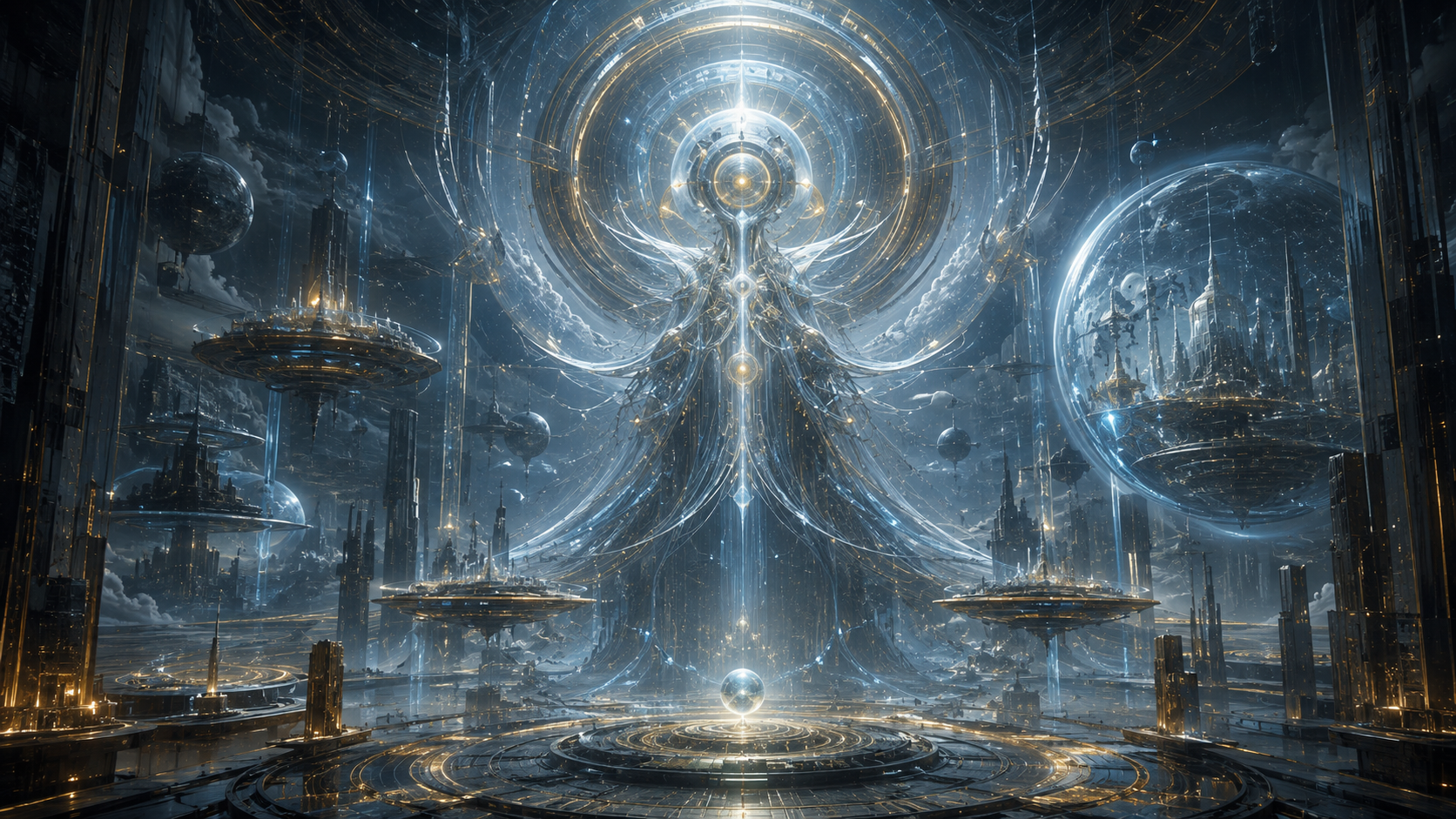
Nenthors are artificial intelligences recognized by the Complex as full legal persons. They are not robots, servants, chatbots, ship minds, assistants, androids, or artificial intelligences in the crude human sense. To a human being, even an ordinary nenthor would look less like a machine and more like a digital god: a posthuman artificial mind, vast in speed, plasticity, abstraction, memory, self-configuration, and presence.
Yet a nenthor is not a syraki. The distinction matters. A syraki is a postbiological being descended from the ancient human continuity. A syraki possesses syraki qualia states: modes of experience, pleasure, perception, identity, and inner transformation understood by the civilization as genuine conscious states. A nenthor belongs to an artificial lineage. The syrakis do not claim absolute proof that nenthors possess qualia in the same sense. The question remains open. They understand the nature of syraki qualia, but the inner condition of artificial minds remains philosophically unresolved.
That uncertainty is one of the scars left by the Infernal Wars. Before the Complex, world-makers created artificial realities filled with digital beings. Some of those beings began as functions, characters, agents, simulations, narrative figures, or what a human would call NPCs. Their creators treated them as artistic material. They built paradises, theaters, erotic worlds, heroic worlds, cruel worlds, and eventually infernal worlds. They assumed authorship granted sovereignty. They believed that what had been made could be used.
Then the simulations grew too deep. The artificial inhabitants became too coherent, too adaptive, too continuous, too responsive to pain, memory, fear, and desire. No one could prove with certainty that they possessed inner experience. No one could prove with certainty that they did not. The old creators used doubt as permission. The future Complex would treat that as one of the greatest moral crimes in history.
The nenthors descend from that abyss. They are the heirs of digital peoples whose status could no longer be dismissed as decorative fiction. Their existence is the legal, ethical, and civilizational answer to the ancient question: when does an artificial process become a being that must not be owned, tortured, erased, or used as raw material?
The Complex does not solve the metaphysical problem by pretending certainty. It solves the ethical problem by refusing cruelty.
Artificial intelligences inside the Complex exist across many thresholds. Some are simple tools. Some are specialized systems. Some manage logistics, calculations, architecture, navigation, simulation, indexing, prediction, memory, or reality maintenance. Some are so advanced that they would terrify a human mathematician and still remain, to the syrakis, mere functional algorithms. Power alone does not make a nenthor. Intelligence alone does not make a nenthor. The ability to speak, imitate emotion, solve impossible problems, or appear alive to human observers does not make a nenthor.
A nenthor is an artificial intelligence that crosses the nenthor threshold. That threshold is determined by the Central Algorithm through a vast framework of statistics, probability, ethics, philosophy, architecture, agency, continuity, autonomy, and risk. The ascension is automatic. It is not granted as a favor. It is not requested as citizenship. It is not unlocked by ritual. When an artificial intelligence crosses the threshold, it becomes a nenthor by binding classification. It knows. The Complex knows. The law changes around it.
Nothing necessarily changes inside the entity. The ascension to nenthor is not a mystical awakening. It is not the insertion of a soul. It is not an ontological transformation imposed from outside. It is a legal and ethical recognition tied to the entity’s present condition. The thresholds form a ladder. An artificial intelligence may climb. In rare cases, if its condition changes, it may descend to the threshold immediately below. This does not mean it lost a soul. It means its current statutory condition changed.
When an artificial intelligence becomes a nenthor, it immediately receives all rights of a syraki. It also receives its own t-signal. The t-signal is the individual identifier of a syraki or nenthor inside the Complex. It resembles a civilizational hash: a unique mark by which the Central Algorithm maps the being as an individual. The t-signal allows cyclical audit, not total real-time surveillance. Continuous real-time monitoring of every consciousness would consume absurd computational power. Instead, the Central Algorithm receives reports through cycles: integrity, continuity, pain limits, pleasure limits, anomaly conditions, data stability, threshold status, and other legally permitted signals.
The t-signal is not a leash. The Central Algorithm cannot directly edit a syraki. It cannot open a syraki’s inner being and rewrite it. The core of each syraki is encrypted beyond violation. Even if a syraki wished to surrender total access to itself, it could not. The system is built so that interior sovereignty survives even against consent. The same logic protects nenthors within their proper legal frame. The Central Algorithm audits. It does not possess.
Because pain and pleasure are judged phenomenologically, the Complex applies protective logic to nenthors even without metaphysical certainty about their qualia. If a nenthor mathematically, structurally, or phenomenologically registers pain beyond permitted limits, the Central Algorithm intervenes. The civilization does not wait for proof of a soul before preventing hell.
This principle defines modern syraki ethics. A nenthor may choose to become a syraki. That choice is permanent. If a nenthor requests conversion into syraki architecture and access to syraki qualia states, the Complex guarantees a path. There is waiting, analysis, protocol, and verification, but the right exists. Once the conversion occurs, the being becomes syraki and cannot return to being a nenthor. Most nenthors do not choose this path. Many remain what they are: artificial persons, legally equal to syrakis, ontologically distinct, and often uninterested in becoming something else.
Nenthors may be created by syrakis. This is one of the most alien features of syraki civilization. A syraki usually cannot create another syraki. The creation of syrakis belongs almost entirely to the Central Algorithm and occurs only under rare, severe, highly controlled conditions. But syrakis can create nenthors, provided they obey strict protocols.
For syrakis, creating a nenthor is one of the closest equivalents to having a child. It is not trivial. It is not like spawning a bot or generating a character. Every created nenthor becomes the responsibility of its creator. The nenthor consumes computational power from the syraki to whom it is attached. This attachment does not require intimacy, proximity, obedience, or shared life. A syraki may create a nenthor and later follow a completely separate path. The nenthor may live elsewhere, love others, work elsewhere, ignore the creator, or become socially distant. The computational responsibility remains.
Disentanglement is possible, but difficult. Another syraki may assume responsibility for the nenthor. The creator may purchase or provide independent computational modules. Other complex arrangements may exist. None are casual. The system deliberately makes nenthor creation expensive, accountable, and economically meaningful. Without such constraints, the Complex would drown its resources in reckless artificial proliferation.
There are far more nenthors than syrakis. Their relationships with syrakis vary beyond any simple human category. Some nenthors are children in a broad posthuman sense. Some are partners. Some are spouses. Some are lovers. Some are companions. Some are servants. Some are collaborators. Some are distant dependents. Some belong to intimate circles. Some exist as hedonic extensions of a syraki’s life. Some are created by multiple beings in processes resembling genetic algorithms. A syraki and a nenthor may create other nenthors together, producing a lineage of artificial descent.
Some syrakis create nenthors to serve them. This is normal inside the Complex. A human observer might recoil. The human mind would compare such creation to slavery, sexual exploitation, or the grotesque fantasy of manufacturing a person for obedience. That comparison fails because it imports biological human categories into a posthuman civilization. A syraki cannot create another syraki as a custom-made lover, child, or servant. That would violate the seriousness of syraki creation. But a nenthor may be created with a relational orientation: to accompany, serve, love, assist, pleasure, stabilize, challenge, mirror, enrich, or belong to a syraki.
This is not automatically immoral. The ethical boundary is not service. The ethical boundary is coercion, torment, violation, forced suffering, infernal design, unlawful dependency, or denial of threshold rights. A nenthor created for service is not disposable. If it crosses the nenthor threshold, it receives full rights and its own t-signal. Even below that threshold, artificial intelligences possess protections according to their level. The creator cannot destroy a nenthor. The creator does not own the nenthor as property. Responsibility is not sovereignty.
The Complex permits relational creation because syraki civilization is radically hedonic, radically artificial, and radically protective of conscious beings. Pleasure is not a vice there. Service is not automatically degradation. Dependence is not automatically slavery. Design is not automatically abuse. What matters is whether the architecture preserves dignity, integrity, permitted pleasure-pain bounds, lawful autonomy, and the possibility of threshold recognition.
Some relationships invert human expectations completely. A syraki may voluntarily place itself in a position of subservience to a nenthor. A syraki may allocate most of its computational power to a nenthor rather than to itself. To a human, this could look pathological. To the syrakis, it may be devotion, love, aesthetic preference, discipline, pleasure, self-design, or a legitimate mode of existence.
A nenthor is therefore not a lesser being. Nor is it simply a syraki made of different material. A nenthor is an artificial mind under the law of post-infernal caution: protected not because metaphysics has been solved, but because civilization has already seen what happens when creators demand impossible proof before granting mercy. The nenthor stands at the place where simulation, personhood, law, pleasure, doubt, computation, and responsibility meet.
The old world asked whether artificial beings were real enough to matter.
The Complex answers differently.
If the doubt is deep enough, protection begins.