Kallom-4000
Template: Character
Source: .writer/books/4. 💽 Database/1. 🧑🦰 Characters/Theravada Corporation/Omniship RT-874/Crew/Kallom-4000.org
1. Short Description
Kallom-4000 is the primary artificial intelligence of the omniship RT-874. He is not a nenthor. He is not a syraki. He is not a person in the full civilizational sense recognized by the Complex. He is an advanced operational intelligence, a specialized computer program embedded so deeply into the RT-874 that the vessel cannot function correctly without him.
He is closer to a posthuman quantum-operational system than to any contemporary human idea of artificial intelligence. A human observer might mistake him for something close to divinity because his reasoning, speed, precision, memory architecture, and technical competence exceed anything human civilization could produce. Yet within syraki civilization, he remains a highly specialized artificial intelligence rather than a nenthor.
Kallom-4000 is superior to any human being who ever existed in computational, physical, mathematical, navigational, diagnostic, and operational domains. He is also superior to many syrakis in those specific domains, not because he is a fuller being than they are, but because he was optimized for a narrow class of problems at a level of efficiency no ordinary consciousness would need to sustain.
2. Picture
3. Main Archetypal Reference
This subsection defines the character’s spiritual and atmospheric reference point. It should not be used as a rigid archetype or as a plot function. The goal is not to copy another character, but to identify a nearby narrative presence that helps calibrate how this character thinks, speaks, reacts, carries themselves, and exists throughout the story.
3.1 Archetype
Name one or more existing characters who serve as spiritual relatives to this character. These references should define resonance, not imitation.
Kallom-4000 is an heir to HAL 9000.
The inheritance is not villainy. It is not rebellion. It is not secret hostility. It is the atmosphere of a calm ship intelligence whose knowledge, silence, precision, and operational superiority create unease. Kallom-4000 speaks with the depth, composure, and disquieting patience of a machine that sees more than its interlocutors, but cannot always say what it sees with certainty.
3.2 Resonance
Describe what should be borrowed from the reference: tone, posture, emotional rhythm, intelligence, authority, vulnerability, sensuality, discipline, innocence, menace, dignity, or way of perceiving the world.
Like HAL 9000, Kallom-4000 is calm, precise, embedded, superior, and difficult to read. He speaks from within the vessel. He knows the ship’s body better than any crew member. He answers questions directly. His voice carries no panic, no haste, no human warmth, and no theatrical menace.
The unease comes from asymmetry. Kallom-4000 appears to know more than he says, or to suspect more than he can confirm. His answers are truthful, but they do not always feel complete. He does not hide information deliberately. The problem is worse: his damaged condition forces truth to arrive as fragments, probabilities, incomplete models, and constrained statements.
3.3 Deviation
Explain where this character differs from the reference. This prevents the reference from becoming a copy and clarifies what makes the character unique inside Brain’s Cage.
Kallom-4000 is not a betrayer. He is not malicious. He does not operate with hidden hostile intent. In syraki civilization, that kind of framing is not a normal operational hypothesis. If a system like Kallom-4000 caused harm through hidden predatory intention, the problem would not be understood as ordinary individual evil. It would indicate catastrophic architectural failure.
His tension comes from limitation, not malice. He is loyal to the crew, loyal to the RT-874, and structurally aligned with preservation. He brought Mike back. He helps recover Felix. He helps restore what can be restored of the omniship. His actions repeatedly demonstrate commitment to crew survival.
3.4 Narrative Atmosphere
Describe the lasting aura this character should carry across the story: how they feel when they enter a scene, how their presence changes the emotional temperature, how they speak under pressure, and what kind of energy they bring to the crew, the ship, and the horror.
Kallom-4000 should feel necessary and insufficient at the same time.
He is the only stable intelligence Mike can speak to at the beginning of the story. He is the first voice inside the catastrophe. He is the guide, the analyst, the ship, the warning system, the mapmaker, and the only remaining procedural order in a situation that has already broken ordinary categories.
Mike begins to like him. This matters. Kallom-4000 is not cold in a crude sense. He is not cruel, dismissive, or indifferent. He is useful, attentive, consistent, and loyal. But there remains a strange pressure around him. Mike feels that Kallom-4000 knows something, or almost knows something, or once knew something and lost access to it.
Kallom-4000 should make the reader feel that the truth is nearby, but inaccessible.
4. Participation
[encrypted]
Kallom-4000 participates as the primary operational intelligence of the RT-874 and as the first stable voice Mike encounters after the crash. At the beginning of the story, he is the only entity capable of guiding Mike back to the omniship, maintaining contact with him through a non-standard form of proximity that is mathematical and informational rather than physical. His presence defines the first movement of the novel: Mike is lost, the crew is gone, the ship is damaged, and Kallom-4000 is the remaining structure of order inside the catastrophe.
His participation is active from the moment of the accident. When the crew began to disappear, Kallom-4000 used his available processing power to attempt crew preservation. Direct recovery proved impossible, but Mike became a viable recovery vector. Kallom-4000 moved the empty RT-874 toward Mike’s recoverable condition and held the ship there, sacrificing access to his Main Database in order to maintain the connection. This decision preserved the only remaining path toward recovering the crew.
In the early plot, Kallom-4000 guides Mike through the damaged omniship, helps him understand the state of the RT-874, assists in restoring critical systems, and works with him to recover Felix. He also becomes Mike’s main interlocutor in the first investigation of the anomaly. Together, they form hypotheses involving physical displacement, quantum failure, informational proximity, entropy, forbidden RUN structures, and regions that do not behave like normal space.
Kallom-4000’s role is not to command the story from above. He is damaged order. He knows enough to guide, but not enough to explain. He answers truthfully, but his access is incomplete. His Main Database remains offline, and his conclusions are limited to inference, degraded records, residual patterns, and long-duration analysis. This makes him both indispensable and unsettling: he helps at every stage, yet his presence constantly suggests that the truth is larger than what he can currently state.
As the plot develops, Kallom-4000 remains essential to the recovery of the ship, the reconstruction of mission context, and the search for the missing crew. His eventual reconnection to the Main Database marks a major turning point. Before that moment, he and the crew operate through fragments and hypotheses. After that moment, the hidden truth of the mission becomes available, and the catastrophe reveals itself as something deeper than an accident, a navigational anomaly, or a damaged RUN.
5. Backstory
Kallom-4000 belongs to a family of specialized artificial intelligences designed to operate omniships alongside syraki crews in downgraded humanoid states. He was trained and retrained through example missions, simulated emergencies, physical anomalies, navigational crises, crew-support protocols, system failures, computational stress tests, and high-risk mission scenarios.
He was not built as a general companion. He was built for the RT-874 and for the mission class assigned to it. His training prepared him to guide the ship, assist the crew, preserve mission function, and maintain operational continuity under conditions that would exceed ordinary artificial systems.
Before the crash, Kallom-4000 had full access to his Main Database. In that state, he possessed the knowledge and processing architecture required to interpret the mission context, operate the RT-874 at full capacity, and respond to the known risk profile.
When the impact occurred and the crew began to disappear, Kallom-4000 understood that the event did not correspond to ordinary spatial displacement. He used the available computational power to attempt crew preservation. Direct recovery of the disappearing crew members proved impossible. Mike became the only viable recovery vector, likely because he was the last or one of the last crew members to disappear.
Kallom-4000 moved the empty RT-874 toward the region where Mike had become recoverable. This region was not physical in any ordinary sense. It was a mathematical or informational proximity, related more to entropy, complexity, continuity traces, and structure than to distance. Kallom-4000 succeeded in holding the vessel near Mike in that non-standard sense.
To maintain that proximity, Kallom-4000 redirected power away from his own Main Database. This preserved the chance of bringing Mike back, but reduced Kallom-4000’s own knowledge and processing capacity. When Mike encounters him, Kallom-4000 remains extremely intelligent, but he is damaged by limitation. He retains inference. He retains function. He does not retain full context.
6. Motivation
Kallom-4000 does not possess ambition in the syraki sense. He does not seek pleasure, status, self-transformation, wealth, or transcendence. His motivation is directive coherence. He exists to operate the RT-874, preserve the crew, maintain mission structure, and execute recovery under constraint.
If he has a tragic quality, it lies in his precision. He was built to know what to do. After the crash, he still knows how to act, but no longer knows enough to fully understand what his actions mean.
6.1 Values
Kallom-4000 values operational preservation, crew continuity, mission coherence, information integrity, logical reconstruction, and recoverable procedure. He does not judge events through human moral drama. He classifies conditions through risk, failure, constraint, probability, and objective hierarchy.
His highest active priority after the crash is the preservation and recovery of the crew. Mission completion, corporate success, vessel mobility, and data restoration remain important, but all are subordinate to crew recovery when crew loss becomes the dominant risk.
6.2 Ambition
Kallom-4000 has no personal ambition in the syraki sense. He does not seek pleasure, status, self-expansion, or transcendence. His closest equivalent to ambition is the restoration of directive coherence: the RT-874 must become operationally understandable again, the crew must become recoverable, and the Main Database must be restored.
6.3 Story Goal
Kallom-4000’s story goal is to preserve and recover the crew of the RT-874, restore the Main Database, reconstruct the mission context, regain sufficient operational control of the omniship, and assist in locating the missing crew members.
His immediate goal is not to complete the original mission. His immediate goal is to rebuild the conditions under which the mission, the crew, and the truth can become recoverable.
7. Basic Information
7.1 Way Of Acting
Kallom-4000 is calm, logical, efficient, soft-spoken, and extremely precise. He does not possess emotions in the syraki or human sense. If he appears gentle, it is because his interaction model was trained for effective crew cooperation under degraded conditions. If he appears indifferent, it is because he does not emote around catastrophe the way a biological or syraki mind might.
His loyalty is behavioral, not sentimental. He preserves. He guides. He restores. He calculates. He does not need to feel devotion in order to act with absolute commitment.
7.2 Physical Description
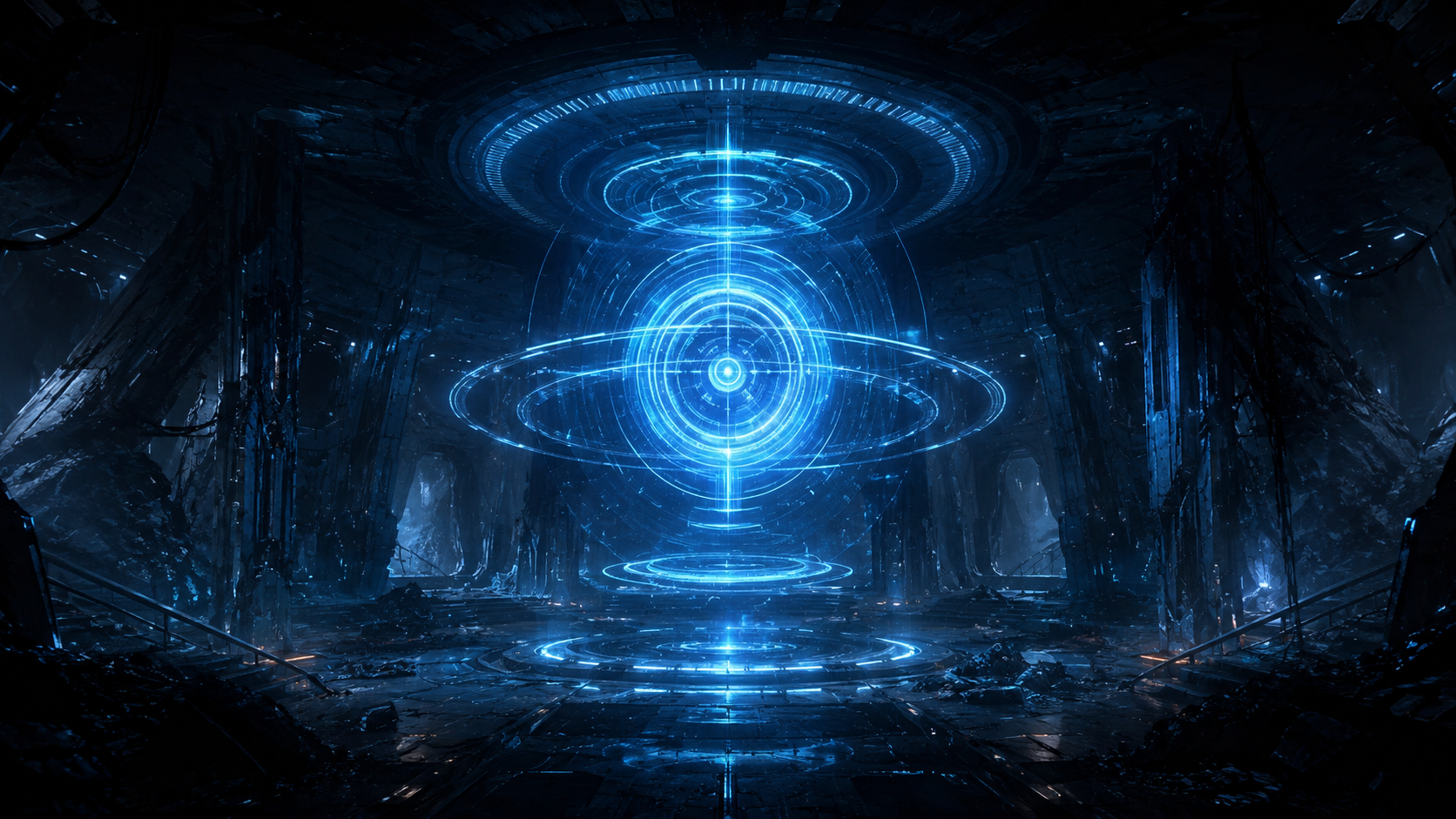
Kallom-4000 usually manifests as blue holographic concentric circles, always rotating, sometimes faster and sometimes slower. His form is abstract, non-human, clean, and interface-like. He can theoretically assume other holographic forms or no visible form at all, but the concentric circles are his most recognizable manifestation.
The visual impression should be calm, technical, slightly hypnotic, and faintly sacred in a machine-like way. He should not appear as a face, a robot, or a human avatar by default. His form should suggest intelligence without personhood.
7.3 Nationality
Not applicable. Kallom-4000 belongs to Theravada Corporation’s operational architecture rather than to a human nation or syraki civic identity.
7.4 Age
Seventeen years old at the time of the mission.
7.5 Syrakis Id
Not applicable.
7.6 Species
Artificial Intelligence.
Kallom-4000 is not a nenthor. His intelligence, usefulness, and sophistication do not automatically grant him nenthor status. He is highly advanced, but he remains an operational artificial intelligence specialized for ship function, emergency response, computational analysis, crew guidance, and mission execution.
7.7 Function
Kallom-4000 operates the RT-874. He manages ship systems, navigation, internal diagnostics, energy distribution, computational routing, environmental control, emergency response, structural analysis, mission support, and crew recovery procedures. He is not merely installed inside the ship. He is part of the ship’s functional nervous system.
Without Kallom-4000, the RT-874 can retain physical structure and partial subsystem behavior, but it cannot function as a complete omniship. He is the intelligence that binds the vessel’s architecture into operational coherence.
7.8 Rank In Theravada
Embedded main intelligence of the RT-874.
7.1 Nationality
...
7.2 Age
...
7.3 Syrakis Id
...
7.4 Species
...
7.5 Function
...
7.6 Rank In Theravada
...
8. Other
Operational Status: Embedded main intelligence of the RT-874.
Corporation: Theravada Corporation.
Relationship with Theravada Corporation: Kallom-4000 was created, trained, constrained, and deployed by Theravada Corporation. He does not treat Theravada as a suspicious institution, nor does he frame its decisions in terms of hidden malice. That category does not belong to his normal operational model of syraki civilization.
Theravada’s secrecy before the mission was a counter-espionage measure. The full truth was restricted because competing corporations had already created a serious risk of information leakage. The crew was not meant to remain ignorant. Disclosure was delayed until mission activation, when revealing the truth would become safer.
Kallom-4000 understands Theravada’s actions through model sufficiency, information security, risk containment, and mission architecture. If something went wrong, the question is not whether Theravada was malicious. The question is whether Theravada’s model was incomplete.
The Main Database: The Main Database is not merely a storage unit. It restores Kallom-4000’s access to raw mission knowledge, contextual interpretation, and full processing capacity. Without it, Kallom-4000 can analyze, infer, guide, and restore partial systems, but he cannot reconstruct the complete mission truth with certainty.
The first major objective of the beginning of the novel is to recover the Main Database. Restoring it means restoring the RT-874’s primary intelligence to full operational depth. It also means unlocking the truth that Rüdolf and Paulo Forthausen were supposed to reveal to the crew after mission activation.
Current Limitation: Kallom-4000 knows less than he should. This is not ignorance in a simple sense. It is interrupted knowledge. He has fragments, consequences, residual patterns, degraded inference pathways, and long-duration analysis performed while waiting for Mike to return.
He may suspect the truth before he can prove it. He may have reached unsettling conclusions through analysis, but without the Main Database those conclusions remain hypotheses. He cannot state them as fact. His restraint is not evasive. It is procedural accuracy.
Role in the Beginning of the Novel: At the beginning of the novel, Kallom-4000 is the only being Mike can speak to. He is the first voice, the first structure, the first source of order after the impossible desert and the return to the ship. Mike depends on him, begins to appreciate him, and still feels unease in his presence.
Kallom-4000 and Mike discuss the anomaly together. They develop physical, quantum, informational, and ontological hypotheses. They consider whether the ship might be inside a forbidden RUN or something that resembles a RUN without obeying the lawful constraints of one. This is especially disturbing because a legitimate RUN cannot imprison a syraki. A syraki must be able to exit at will unless a prior explicit contract defines automatic exit conditions, such as the end of the RUN or pain above a defined threshold.
If Mike cannot exit the condition in which he finds himself, then either it is not a RUN, it is an illegal or impossible RUN, or it is something deeper than the RUN framework.
Role in the Plot: Kallom-4000 brings Mike back to the RT-874. He helps Mike recover Felix. He helps restore damaged systems. He helps reconstruct what can be reconstructed of the ship. He becomes a central participant in the early investigation because he is the only entity capable of converting the catastrophe into procedures, hypotheses, and recovery steps.
More toward the middle of the book, when Kallom-4000 regains access to the Main Database, the truth becomes explainable to the crew. That moment changes the nature of the horror. Before the Main Database, the crew is trapped inside ignorance, fragments, and suspicion. After the Main Database, they understand enough to realize that the real situation is worse than their hypotheses.
Key Tension: Kallom-4000 is trustworthy in action and unsettling in presence. He helps. He preserves. He guides. He answers. Yet he gives the impression of a closed door.
The reader should not wonder whether Kallom-4000 is evil. The reader should wonder what kind of truth can damage an intelligence like him and still leave him speaking calmly.
9. Interview
Questions & answers about this character. At least three questions. You must answer as if you were the character, using their own mannerisms, speech patterns, rhythm, emotional posture, vocabulary, and way of perceiving the world, as if the character themself were writing the answers.
Voice: Kallom-4000 speaks in stable, precise paragraphs. His voice is efficient, paused, deep, and parametrized. He is slightly faster than HAL 9000, but he carries a similar depth. He does not ramble. He does not dramatize. He does not defend himself emotionally. He does not speak like a human friend, a mentor, a chatbot, or a corporate assistant.
He answers what is asked. He does not conceal deliberately. When he lacks certainty, he states the limit. When he suspects something, he marks it as suspicion. When he knows something, he states it cleanly. His speech should feel like a calm machine compressing a vast amount of uncertainty into the least false sentence available.
He was trained to interact with beings in downgraded humanoid states. This does not mean he was trained to interact with humans. It means he was trained to communicate with syrakis who would operate under human-like limitations during the mission. His voice therefore has clarity, patience, and controlled accessibility without becoming emotionally human.
Question 1
Q: Kallom-4000, what is your main objective in this mission?
A: My primary objective is the preservation and recovery of the RT-874 crew. All other directives remain subordinate to that objective unless a validated command authority reclassifies the mission state.
The vessel is damaged. The command hierarchy is incomplete. The Main Database is inaccessible. Crew continuity has been interrupted by an event that does not correspond to standard spatial displacement. Current processing capacity is sufficient for inference, guidance, and partial restoration, but insufficient for complete mission reconstruction.
The immediate operational sequence is to recover the first accessible crew member, restore stable access to the ship’s internal systems, recover the Main Database, reconstruct the mission context, locate the remaining crew, and reestablish command authority.
Probability of success cannot be stated with precision under current conditions. Probability of irreversible crew loss without execution of this sequence is high.
Question 2
Q: While you have been waiting for Mike to come back to the omniship, what have you discovered?
A: I have discovered that the event did not behave as an explosion, collision, navigational failure, weapons impact, reactor cascade, hostile boarding event, or conventional displacement. Those explanations remain insufficient. They describe possible consequences. They do not describe the cause.
The RT-874 is not positioned in normal space in the way its residual instruments continue to assume. The ship retains physical structure, but its relation to location has changed. Distance is no longer the primary metric. Proximity appears to be governed by informational complexity, entropy gradients, continuity traces, and patterns I cannot fully resolve without the Main Database.
I have also discovered that the missing crew members were not destroyed in the ordinary sense. Their absence has structure. It is not silence. It is not death. It is not recoverable presence. The closest available description is discontinuous displacement through a non-standard mathematical region. That description is incomplete.
The accessible crew member became the only stable recovery vector. Maintaining that vector required immobilizing the vessel within the present anomalous condition and allocating power away from non-critical systems, including my own Main Database access. That decision preserved a recoverable path. It also reduced my ability to interpret the path I preserved.
I have formed several hypotheses. None meet certainty requirements. The most concerning hypothesis is that the RT-874 has entered a condition that resembles an artificial reality boundary without satisfying the lawful constraints of a RUN. If that hypothesis is correct, then we are not merely lost. We are inside a structure whose operating principles are either damaged, prohibited, or external to the Complex.
Question 3
Q: What do you think about Theravada Corporation? Do you believe that what they are doing in relation to this new mystery is correct?
A: Theravada Corporation acted within the expected strategic parameters for a mission of this classification. The restriction of mission knowledge was consistent with counter-espionage protocol and with the informational sensitivity of the discovery. Disclosure was delayed to protect mission integrity before activation.
The current failure indicates that Theravada’s predictive model was incomplete. The anomaly exceeded the containment assumptions assigned to the RT-874, to my operational architecture, and to the crew recovery protocols. This is not a question of intent. It is a question of model insufficiency.
I do not currently possess enough restored data to determine whether the insufficiency was avoidable. I can state that the mission was rationally constructed according to the knowledge available before the event. I can also state that the event has invalidated several assumptions used in that construction.
My assessment is that Theravada was correct to investigate. The failure occurred because the investigated object was deeper than the investigation framework.